How breach data ends up in broker databases: a simple map
Wondering how breach data ends up in broker databases? This plan explains the chain from stolen records to appends, matching, resale, and re-listing.
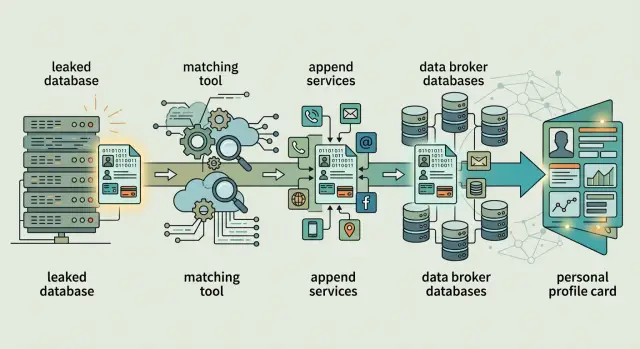
What this looks like in real life
Most people do not notice this chain when the breach happens. They notice it later, when an old phone number, a past address, or an email they stopped using shows up on a people-search site next to details that are current.
That is what makes the whole process confusing. The data does not stay attached to the site where it first leaked. It moves. It gets copied into breach collections, matched against other records, and mixed with newer scraps from other places.
A common pattern looks like this:
- A shopping site leaks your old email and home address.
- A second breach ties that same email to a phone number.
- A broker matches both to a name from another source.
- One newer detail updates the profile enough to make it look current.
Broker listings feel invasive for a reason. They are often not fully right, but they are right enough. A record can start as a half-empty row in a dump and still turn into a profile with your full name, age range, relatives, past cities, and a phone number that still works.
If you moved two years ago and changed jobs, an old breach can still follow you. A broker can take your old address from one leak, your personal email from another, and a newer city or employer from somewhere else. Once those pieces line up, the result looks like one clean person record even though it came from several messy sources.
One breach also rarely leads to one neat, isolated problem. A single leaked record can spread into many databases, then get merged again and again. Even after one listing is removed, the same details can reappear when another broker rebuilds your profile from the same old scraps.
Tracing that by hand takes time. The hard part is not finding one bad listing. It is dealing with the way old breach data keeps getting reused, refreshed, and sold as if it were new.
What is usually inside a breach dump
Most breach dumps look less dramatic than people expect. They are often just rows from a login table, customer database, or exported spreadsheet, with each row tied to one account.
What matters is context. Even a plain record can give someone a strong starting point. The most common fields are email addresses, usernames, and password hashes. A password hash is a scrambled version of a password. You usually cannot read it like normal text, but it still helps connect accounts from the same leak. In some cases, it can also help test whether someone reused a password elsewhere.
Some dumps go further. They may include a full name, phone number, date of birth, mailing address, IP address, or answers to account recovery prompts. Older consumer leaks often have shipping details, billing details, or profile text that people forgot they ever entered.
Dates matter more than they seem to. An account creation date, last login date, purchase date, or password reset date helps place the record in time. That makes it easier to compare with other records and decide whether two accounts likely belong to the same person.
Account IDs look boring until you see what they do. A customer number, user ID, order ID, or loyalty ID can tie a record to a specific service and time period. That extra context makes later matching much easier.
A small example makes this clearer. A leak from a shopping site might include an email, username, hashed password, phone number, apartment address from 2021, a customer ID, and the last order date. No single field proves much on its own. Together, they point to one real person.
Old data still carries weight. People keep email accounts for years, reuse phone numbers, and leave traces of old addresses in sign-up forms, delivery records, and public files. Even stale data can help with matching when another database fills in the missing pieces.
How one leaked record gets matched to a person
Most matches start with one field that travels well across the internet: an email address. People reuse the same email for shopping sites, apps, newsletters, and old forums. Once that address appears in a breach dump, it becomes an anchor for matching.
An email alone does not always tell the full story. Confidence rises when the same record also includes a name, city, ZIP code, or age range. Even rough details can be enough. If one file says A. Johnson in Denver, age 45-54, and another has the same email plus a full first name, a broker may treat that as the same person.
Old account details still have real matching power. A phone number you stopped using, a mailing address from years ago, or a username tied to a forgotten account can connect back to you when it overlaps with newer files. People often assume stale data is harmless. In practice, it can act like a bridge between a breach record and a current identity.
The matching process is usually based on probability, not perfection. A broker does not need every field to be right. If four details line up and one is wrong, the record may still stay in the database. That is why you sometimes see listings with an old city, a misspelled name, or a relative tied to the wrong address. The record is flawed, but still close enough to keep.
Picture a simple example. An old retailer breach includes an email, a partial name, and a shipping address from 2019. A second file from a marketing vendor has the same email and a newer city. A third source adds an age band. None of those files is complete on its own, but together they can point to one person with a fairly high score.
This is also why personal data removal takes more than deleting one listing. If the same person is matched through several old records, new listings can keep appearing even after one version is removed. The data may be messy, but the match can still stick.
Where append services and enrichment tools fit
A breach dump rarely starts as a full profile. More often, it is a thin record: an email address, an old password, maybe a name, maybe nothing else.
Append services fill in the blanks. If a file has one strong identifier, they try to attach a phone number, street address, age range, or other contact details. Think of an email address from a leaked shopping account. On its own, it is limited. If that same email turns up in a marketing list, a warranty registration, and a people-search database, an append service can connect those points and add missing fields.
Enrichment tools go a step further. Instead of filling one empty box, they pull from public and commercial sources to make the record more useful. That can mean likely relatives, past addresses, job title, household data, or a second phone number.
The match does not have to be perfect in one shot. Small overlaps often do the work. One file matches on email. Another matches on phone number. A third lines up on ZIP code and birth year. Taken alone, each match looks weak. Together, they can be enough to connect several records to one person.
That is why a broker listing can look more complete than the original leak. The breach may have exposed only one piece of you. Append services and enrichment tools add the rest by pulling from places that already had fragments of your identity.
A simple example makes it clearer. Say a breach exposes [email protected] and an old city. A separate database has that email with a mobile number. Another file has the same number tied to a current address. A broker can merge those pieces and end up with a profile that looks current even though no single source had the whole picture.
How brokers turn fragments into a profile
A broker usually does not start with a full, clean file on one person. It starts with scraps. One breach may have an email and password hash. Another file may have a phone number, an old address, or a birth year. A shopping data source may add income range or homeownership guesses. On their own, these pieces look weak. Put together, they can point to one person or one household.
The next step is grouping. The broker matches records that seem to belong together, then rolls them into a single profile. If the same email shows up beside the same phone number in two places, the match gets stronger. If an old address connects to a newer address through a forwarding record, the profile grows.
Many brokers use scoring behind the scenes. They do not treat every match as equally solid. Details that are less likely to be shared or typed wrong get more weight. A repeated email address matters more than a vague age band. A phone number tied to two addresses may matter more than a guessed income range.
Once the score passes the broker's cutoff, the record may be listed, sold, or passed to another seller. That is where the chain gets messy. One broker may buy a profile, add a few details, and resell it to other brokers, lead sellers, or people-search sites. The next buyer may treat that profile as a fresh source even if the original match was only partly right.
This recycling is why removed data can come back. A listing goes down, then a new source file arrives with the same email, phone, or address. The broker matches it again, rebuilds the profile, and republishes parts of it.
For regular people, this feels random. It is not. It is a chain of small guesses, reused over and over. That is why removal is usually ongoing rather than one-time.
A simple example from breach to broker listing
This chain often starts with something small and old, not a full identity file.
Say a clothing store gets breached. The leaked record has Maya's old Gmail address, her ZIP code, and the date she signed up for sale alerts. That does not look like enough to build a people-search page, but it is enough to start matching.
A matching service checks that email against other databases. It finds the same address in a loyalty program record from another retailer, where Maya used her real first and last name. Now the breach record is no longer just old email plus ZIP. It is tied to a person.
Next, an append service fills in the blanks. The vendor connects that matched record to a mobile number and street address from past shipping data, warranty cards, or other marketing files. None of those sources has to be perfect on its own. They just need enough overlap to raise confidence.
Once a broker buys or receives that combined record, it can add broader labels. Maya may get placed into an age range, a likely household size, and a homeownership guess based on other files the broker already has. Those details may be partly inferred, but they still make the profile look complete.
Soon, a people-search site has enough to publish a listing. It may show Maya's name, current or past address, age band, phone number, and possible relatives. The original breach did not contain all of that. The rest came from matching, appending, and enrichment over time.
Each step can look ordinary on its own: a leaked email here, a loyalty record there, one appended phone number after that. Put together, they turn a thin record into something that feels invasive.
How to trace the chain step by step
When people try to figure out where a broker listing came from, they often open too many tabs and lose the thread. A smaller method works better. Start with one email address and one phone number.
Pick the pair you have used for the longest time, even if one of them is old. A full name can create noise. An email and phone number usually give cleaner matches.
Then look for repetition. If the same email shows up on several broker pages, old account records, or breach alerts, write that down. If the phone number appears with two different addresses, save both. Brokers often build a profile by reusing details that keep showing up in different places.
The most telling sign is a mix of old and current information. Say a listing has your current mobile number, an address from 2018, and an email you stopped using last year. That usually means the record was updated over time. It did not appear fully formed. Parts were likely added later through append services or another enrichment source.
Dates help you guess the order. A breach record from 2021, a people-search listing first seen in 2023, and a newer address added in 2024 can suggest a likely chain. You may not prove every handoff, but you can often see when the record was refreshed.
A simple note works better than a complicated spreadsheet:
- Write down one email and one phone number.
- Mark every listing where they appear together.
- Flag details that are outdated versus current.
- Add the date you found each page.
- Save a screenshot before sending any removal request.
That last step matters. Broker pages change fast. A record might vanish, then return with a new age range or a slightly different spelling. If you later compare versions, screenshots make relistings much easier to spot.
You do not need a perfect map. You just need enough evidence to see the pattern. Once the same email, phone number, and old address keep reappearing together, the chain becomes easier to read.
Common mistakes when judging your exposure
Most people judge their risk by the last breach they heard about. That is a bad shortcut.
Changing the password helps with account access. It does not pull your copied data back out of circulation. Your name, email, phone number, old address, or date of birth can still move through resale lists long after the original breach.
Another common mistake is looking only at the company that got hacked. That tells you where the leak started, not where it went next. A leaked record can be sold, matched against other files, then padded out through append services and broker enrichment. By the time it reaches a broker profile, it may include details the breached company never had on its own.
Old details matter more than people think. An address from six years ago can still help connect you to a current listing. The same goes for an old phone number, a past employer, or an email you barely use now.
People also miss their exposure by searching only with current details. They look for their current city and current email, find little, and assume they are fine. Meanwhile, a broker may be using an older address as the anchor record and attaching newer details around it.
A third mistake is treating one removal like a full fix. One broker record going down does not mean the problem is gone. Data gets copied, resold, and rebuilt. A listing removed today can reappear later if another broker still has the same source data.
A better way to judge exposure is to look for patterns: past addresses, old and alternate emails, name variations, family links, household members, and repeated listings across several brokers. That repeated exposure matters most. Personal data removal works best when it is ongoing, not one-and-done.
Quick checks and next steps
Once you see how this chain works, the first job is simple: gather your own details in one place. Most people do this from memory and miss half of it. Old email addresses, a second phone number, or a past apartment can be enough to match you to a much bigger profile.
Make a short working list with the email addresses you still use and the older ones that may still be active in breach records, every mobile or landline number you have used, past home addresses, common name variations, and the broker listings that reveal the most about you. Focus first on pages that expose a home address, family members, or date of birth.
That list gives you something concrete to check against broker pages and breach alerts. If one old Gmail address shows up again and again, that is a clue. If one broker page includes your current address and relatives, move that higher on your cleanup list.
Keep the tracking simple. A plain note with the broker name, date of request, and date you checked again is enough. What matters is seeing patterns, like which sites remove data fast and which ones quietly put it back a month later.
A small example helps. Say an old shopping account leaked your email, phone number, and city. Later, a broker matches that email to a change-of-address file and adds your current street address. Another broker copies that profile. Now you have two listings to remove, not one.
Manual opt-outs can work, but they get old fast when you are dealing with many records and repeat checks. If you do not want to manage dozens of separate forms, Remove.dev automates removals across more than 500 data brokers, keeps watching for relistings, and lets you track requests in one dashboard.
The best next move is not perfect research. It is a short list, a few high-risk removals first, and regular rechecks.