Broker asks for ID upload: how to decide what is safe
If a broker asks for ID upload, use a simple risk framework to decide when to proceed, what to redact, and when to choose another route.
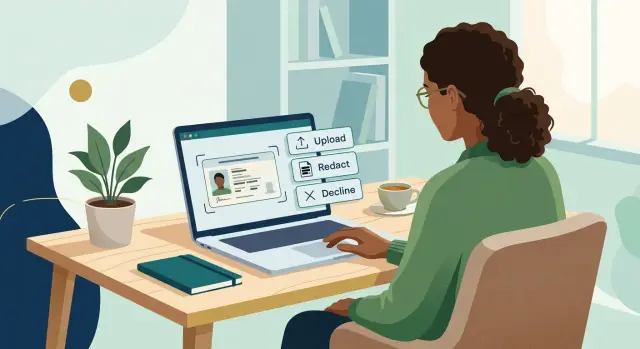
Why this request feels risky
When a broker asks for an ID upload, the discomfort is usually justified. You're being asked to hand over a document that can reveal far more than the broker needs to process a removal request.
A driver's license or passport can include your full name, date of birth, photo, document number, and sometimes your home address. If the broker only needs to confirm that you are the person listed, a full image is often too much. That's why the request feels risky.
There's another problem. The moment you upload an ID, you create one more copy of your personal data in one more system. Even if the broker says the upload is for privacy verification, you still have to trust how it's stored, who can access it, and how long it stays there. A removal request should reduce your exposure, not quietly add to it.
Some brokers ask for ID by default because it's easy for them, not because it's the only way to verify you. A standard form may ask everyone for the same document even when a less sensitive option would work. That doesn't mean the request is fake. It means the process may favor convenience over data minimization.
A simple example shows the difference. If a broker page lists only your name and an old city, sending a full passport scan feels excessive. If the listing includes several people with the same name, stronger proof may make sense. The amount of proof should match the chance of a mix-up.
There isn't one rule that fits every case. The safer choice depends on the broker, the exact record, and your own risk tolerance. Some people will accept a limited upload. Others will only proceed with a redacted ID or a different route. Both reactions can be reasonable.
What the broker may actually need
When a broker asks for an ID upload, they usually don't need every detail on the document. In many cases, they just want enough information to match you to the record and avoid deleting the wrong person.
That usually comes down to two checks. First, they want to know that you are the person named in the listing. Second, they may want proof that you are tied to the address, age range, or other details shown on the page.
They also have a basic reason to slow things down: fake removal requests happen. If anyone could delete anyone else's listing with only a name and email address, their records would be easy to tamper with. So some brokers ask for extra proof before they act.
Still, that doesn't mean they need a clean scan of your whole driver's license or passport. Often, only a small set of fields matters for a match:
- your full name
- part of your address
- a photo, if they use a visual identity check
- a document number or birth date only if their process truly requires it
This distinction matters. If the listing shows your name and old address, the broker may only need those two points to confirm the request. They may not need your license number, full date of birth, signature, height, or other details that create more risk if exposed.
A good rule is simple: compare what the broker already shows with what they're asking you to send. If the request goes far beyond the data in the listing, pause before you upload anything.
That's also why services like Remove.dev don't always jump straight to a full ID upload. Depending on the broker, there may be other ways to verify a request or make a legally valid removal demand without handing over more than necessary.
A 5-step decision check
If a broker asks for an ID upload, pause before you send anything. The safest move is usually the smallest amount of proof that still gets the listing removed.
-
Start with the record itself. Look at what the broker already shows about you. If the page already has your full name, age range, city, and past address, they may not need a full government ID to confirm the match.
-
Confirm the request is real. Use the broker's official site, a support address listed there, or a request portal you opened yourself. If the message came from a strange reply address or asks you to upload files somewhere unexpected, stop.
-
Ask what must be visible. Many companies ask for "an ID" by default, even when they only need two fields, such as your name and address. Ask which parts are required and whether a redacted ID would work.
-
Choose the least sensitive proof that could still work. A utility bill, a bank statement with most details covered, or a redacted ID may be enough. If you do use an ID, cover anything unrelated to the request, such as the photo, ID number, barcode, signature, height, or date of birth, unless they clearly explain why each field is needed.
-
Compare the ask to the actual problem. If the broker listing shows only your name and city, a demand for a full passport image is too broad. When the proof they want feels bigger than the problem you're trying to fix, use another route or walk away.
One rule helps in almost every case: the more sensitive the document, the stronger the reason should be. If they can't explain why they need those fields, that tells you a lot.
When uploading an ID may be reasonable
An ID upload is never risk-free. Still, there are situations where saying yes makes sense.
The clearest case is when the broker already shows the same personal details that appear on your ID, such as your full name and home address. If the record is plainly yours and the company is asking for proof that you are the person in that listing, the extra exposure may be limited. You're not giving them a whole new identity. You're confirming one they already have.
How they ask matters too. A request through a secure upload page inside a removal form is very different from "send us a photo of your ID by email." Email is easy to forward, store badly, or mix into other systems. A dedicated upload page isn't perfect, but it's usually safer.
It also helps when the request is narrow. If the broker says the document is only for identity verification tied to a deletion request, that's more reasonable than a vague demand for "additional documentation." Plain language is a good sign. If they can't explain why they need it, be wary.
Sometimes you simply don't have a lower-risk document that matches the record. Maybe the listing uses your legal name and street address, and your other records don't show both. In that case, an ID may be the only document that closes the loop.
Uploading can be reasonable when most of these are true:
- the listing clearly belongs to you
- the broker uses a proper upload page, not plain email
- the request is limited to identity confirmation for deletion
- you don't have a safer document that proves the same thing
Even then, "reasonable" doesn't mean harmless. It just means the trade-off may be acceptable.
When to redact first
Redact first when the broker seems to need proof of identity, but not every detail on the document. That's common. A broker may only need to match your name and address to the listing, or confirm that you are the person making the request.
In that situation, a full ID is usually more exposure than needed. A full scan can reveal details that have nothing to do with a deletion request and create a new risk if the file is stored badly, shared internally, or exposed later.
A practical rule is to leave visible only the fields the broker says it needs. If the request says they need your name and mailing address, show those and cover the rest. If they say they also need your date of birth, add only that field.
The first things most people should hide are:
- your photo
- your ID number
- the barcode or QR code
- your signature
- any other field the broker didn't ask for
That's the point of a redacted ID. The document can still be used for matching, but you aren't handing over extra data for free.
If the upload tool or message box allows it, add a short note such as "for deletion request only." That won't stop misuse on its own, but it makes the purpose of the file clear.
Be careful with the edit. Don't just draw a thin black line over text if the original can still be recovered. Flatten the image or export a new copy after redaction so the hidden parts are actually hidden.
Save a copy of the exact file you sent, along with the date and any confirmation message. If the broker later claims your proof was unclear or asks again for more than it needs, you'll have a record of what you already shared.
When to use another route
If a broker asks for an ID upload and the request feels too broad, you don't have to accept the first verification method they offer.
Start by asking what you're actually trying to prove. In many cases, the broker only needs to confirm that you control the email, phone number, or address tied to the record. If that's enough, use that first. A reply from the email shown on the listing, a code sent to your phone, or confirmation of the listed address creates less risk than sending a passport or driver's license.
If they want document-based proof, look for a lower-exposure option. A recent utility bill, bank statement header, or account screenshot may work if it shows your name and address without exposing extra details. Share only what the broker needs to match the record.
Another route is a formal privacy request under CCPA, GDPR, or the law that applies where you live. That changes the tone of the exchange. Instead of arguing about their preferred process, you're asking them to honor a legal right to remove personal data.
This is also where a service like Remove.dev can help. Its process uses direct integrations, browser automation, and privacy-law removal demands to handle requests across hundreds of brokers, which can reduce how often you have to deal with ID checks yourself.
Switch to another route when:
- the broker asks for a full unredacted ID for a simple opt-out
- the document request gives them more data than they already have
- they refuse reasonable alternatives like email or address confirmation
- their privacy terms or handling process are unclear
Sometimes the right move is to walk away for now. A missed opt-out is frustrating. A copied ID is much harder to fix.
A simple example
Mia finds her profile on a people-search site. It shows her full name, an old home address, and two relatives. She wants it gone, but the site replies with a request for a full driver's license upload.
That's where many people stop and think, and for good reason. The real question isn't "yes or no." It's whether the request matches the risk.
Mia doesn't upload the license right away. First, she asks two direct questions: which parts of the ID are needed to verify the record, and will the site accept a redacted copy? She also asks whether another document would work, such as a utility bill or a signed request that lists the exact profile to remove.
The site says it needs enough information to match the listing and will accept a redacted ID as long as the name and address are visible. That's a much better sign than a demand for a full, untouched document.
So Mia sends a redacted ID. She covers the license number, photo, barcode, signature, date of birth, and any other detail the broker doesn't need. She leaves only the fields that match the listing.
That keeps the verification narrow. The broker can compare the visible details to the profile, but it gets much less extra data to store or misuse later.
If the site rejects the redacted copy and insists on a full upload, Mia stops arguing in circles. She tries another route. Depending on where she lives, that may mean sending a legal privacy request under laws like CCPA or GDPR, or using a service that handles the removal process for her.
Mia's rule is simple: share the least amount of proof that can still get the record removed.
Mistakes that create extra risk
When a broker asks for an ID upload, the biggest mistakes usually come from moving too fast. People want the record gone, so they send the first document they have and hope for the best. That can create a second privacy problem while you're trying to solve the first one.
One common mistake is sending the most sensitive ID in your wallet. If a broker only needs proof of name and address, a passport is often far more than they need. The same goes for a full driver's license when a less revealing document could confirm the request.
Another mistake is sending the file through plain email. Email is easy to forward, hard to control, and often stays in multiple inboxes. If the broker has a secure request form on its official site, that's usually the safer route.
People also underestimate how much data sits on an ID image. A barcode, document number, signature, passport MRZ lines, and even a photo can all be useful to someone who shouldn't have them. Many uploads become risky simply because nothing was covered first.
The page itself matters too. Fake forms and lookalike domains are an easy trap, especially if you arrived through a search result or a message in your inbox. Before you upload anything, confirm that you're on the real broker site, not a copy with a similar name.
Poor record keeping causes trouble as well. If the broker loses your request, asks again, or relists your data later, memory isn't enough. Keep a small file with screenshots of the request, the date you sent documents, and copies of replies or confirmation messages. It's not exciting, but it saves time.
If you use a service like Remove.dev, that paper trail also makes follow-up easier. The platform tracks removal requests in real time and keeps monitoring for relistings, which helps cut down on repeated uploads.
Quick checks before you upload
If a broker asks for an ID upload, run through a few calm checks first:
- Compare the broker's record with the proof it wants. If it already shows your full name, address, age, or phone number, a full driver's license may be far more than needed.
- Check whether it explained the reason. "For verification" is weak. A fair request should say what they need to match and why another method won't work.
- See what you can cover. Your photo, ID number, barcode, signature, issue date, and other extra fields often do nothing for a simple removal request.
- Ask whether a safer document works. A redacted ID, a masked utility bill, or a legal privacy request may do the job with less exposure.
- Save the request page, email, and deadline before you respond. Forms change, and later you may need proof of what was asked.
One question matters more than most: does the broker already have the same data it wants you to prove? If the answer is yes, sending a full ID can create fresh risk without adding much proof.
If the broker hasn't explained the need, ask for a narrower option. Many will accept a document with unused fields covered. Leave visible only the parts that match the listing, such as your name and current city or address.
If the request still feels too broad, switch to another route.
What to do next
When a broker asks for an ID upload, slow down and make one clean decision for that broker only. Your goal is simple: get the listing removed without handing over more personal data than the broker needs.
Start a short record for every request. Write down the broker name, the date, what it asked for, what you sent, and the result. That takes only a couple of minutes and saves a lot of confusion later.
That record matters because removal requests rarely end in one step. A broker may approve the request, ask for more proof, or relist your data a few weeks later. Set a reminder to check again after the removal goes through. A 30-day check is a good start, and another one later is even better.
If the request still feels too risky, trust that instinct. You don't need to upload a full ID just because a form asks for it. If a redacted ID, a masked utility bill, or another verification method can do the job, try that first. If none of those options feel safe, use a legal privacy request route if it applies.
The rule is simple: choose the option that removes the record while sharing the least extra information. In practice, that usually means trying no-ID and redacted-ID paths before sending a full document.
If you don't want to judge every case yourself, Remove.dev can automate removals from more than 500 data brokers, track each request in a dashboard, and keep checking for relistings after the first removal. That's useful if you're dealing with many brokers at once or just don't want to manage every form, email, and follow-up on your own.
Do the next small step today: log the broker, pick the lowest-risk verification method that can work, and set a reminder to confirm the record stays down.
FAQ
Do I have to send a full ID if a broker asks for it?
Not usually. Check what the listing already shows, then ask which fields the broker truly needs to match you to the record. If name and address are enough, a redacted ID or another document may do the job.
When is uploading an ID actually reasonable?
Sometimes. It is more reasonable when the listing clearly belongs to you, the broker uses its own upload form instead of plain email, and you do not have a lower-risk document that proves the same thing.
What should I hide on a redacted ID?
Cover anything unrelated to the removal request. In many cases that means your photo, ID number, barcode or QR code, signature, and full birth date, unless the broker clearly says why each field is needed.
Is it safe to email my ID to a data broker?
I would avoid plain email if there is any other option. A broker upload page on its official site is usually safer because email is easy to forward, store in multiple inboxes, and lose track of later.
How can I tell if the ID request is real?
Open the broker site yourself instead of trusting a link in an email, and make sure the request matches the company’s normal removal process. If the address, upload page, or wording looks off, stop before sending anything.
Can I use something other than a driver's license or passport?
Often, yes. A utility bill, bank statement header, account screenshot, or email or phone verification may be enough if it shows the same details as the listing without exposing extra data.
What if the broker refuses a redacted ID?
Push back first. Ask why they need a full unredacted document and whether a redacted copy or another proof method will work. If the answer is vague or the request is broader than the listing, use a privacy-law request or skip that route.
The listing only shows my name and city. Should I still upload ID?
In that case, a full passport or license is usually too much. If the broker only shows limited details, start with a narrower proof method or ask for another way to verify the request.
Can a removal service help me avoid repeated ID checks?
A removal service can reduce how often you deal with these checks yourself. Remove.dev handles removals across more than 500 brokers, tracks each request, and keeps watching for re-listings so you are not restarting the same process over and over.
What records should I keep after I send a removal request?
Keep a copy of the exact file you sent, the date, screenshots of the request page, and any reply or confirmation. That record helps if the broker asks again, loses the request, or puts your data back later.