When a broker says it only uses public data: what to do
When a broker says it only uses public data, here is how to separate public records from broker copies, ask for removal, and keep proof.
What this claim really means
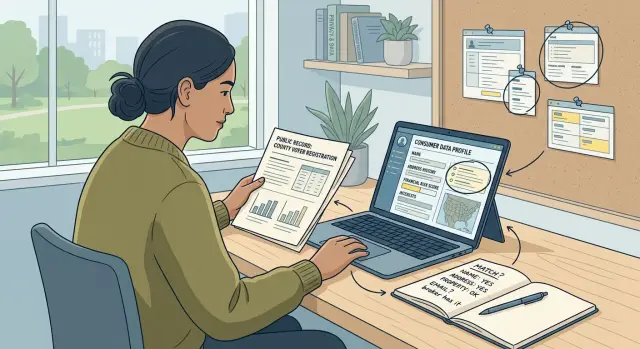
When a broker says it "only uses public data," it is sidestepping the part you care about. The real question is not whether some source record exists somewhere. The real question is whether the page in front of you is the original record or a broker profile built from copied data.
A county office, court, or business registry may publish an original record. A broker page is different. It takes that data, republishes it on a commercial site, makes it searchable by name, phone number, age, relatives, or address, and often mixes it with data from other places.
That repackaging is why broker pages feel far more invasive than the source. The original record might sit in a government database that few people would ever search. The broker turns it into an easy profile.
A property record is a good example. A county site may show ownership of a home. A broker can turn that into a page with your current address, past addresses, possible phone numbers, relatives, and a map. Same starting point, very different result.
So stop asking only, "Is this public somewhere?" Ask a better question: "What am I looking at right now?"
If it is a broker copy, you may still have a path forward. You may not be able to erase every public record, but you can often opt out of data brokers and get copied, bundled, and searchable profiles taken down. Keep that distinction in mind through the rest of the process.
What can still be removed
A broker can tell a half-truth. The source record might be public, but the broker's page is still the broker's own publication. That page, its search result, and the extra data wrapped around it are often fair targets in a data broker removal request.
This is where many people give up too early. They hear "public data" and assume the case is over. Usually it is not.
Brokers rarely copy just one record and leave it alone. They pull bits from many places and stitch them together under your name. One page might combine a property record, a voter file, a phone database, and old address history. Even if one source stays public, the assembled profile can still be removable because the broker created it and controls how it is published.
The extra details are often the easiest part to challenge. Phone numbers, personal email addresses, relatives, age ranges, and old addresses may not appear in the original record at all. The broker added them, inferred them, or matched them from other databases. If the site shows more than the source, ask for removal of the whole profile, not just one line.
Search results matter too. A broker may keep a page that makes your information easy to find by name, city, or age. That search page is its own tool for exposing your data. It makes sense to ask for that page to be removed or hidden as well.
Watch for duplicate profiles. Some sites create multiple listings for the same person because they pulled the same source into separate records. If you see duplicates, include every profile URL and say they appear to describe the same person.
When you write your request, keep the ask concrete. Name the main profile page, any duplicate profiles, site search results tied to your name, and any extra contact details or relatives attached to the listing.
How to tell a source record from a broker copy
When a broker says it only uses public data, the first job is simple: find the record it claims to rely on. That source is usually a county office, court site, business registry, or property database run by a government agency. If the broker cannot point to a real source, its claim gets weaker fast.
Start with the broker page. Look for a case number, parcel number, filing date, county name, or agency name. Then search the official site for the same record. Once you have both pages open, compare them side by side.
The differences usually jump out. The source record may contain only a few facts. The broker page often adds much more:
- extra addresses beyond the source page
- age, relatives, phone numbers, or email addresses
- photos, maps, or neighborhood views
- estimated income, home value, or risk scores
- "possible associates" and similar guesswork
If the county site shows only a property owner name and parcel number, but the broker page shows a map pin, past addresses, relatives, and a photo, that is not a simple mirror of the source. It is a packaged profile. That matters when you send a removal request, because you can point to the broker's added material instead of arguing about whether the original record exists.
Save proof while you compare. Take screenshots of both pages on the same day if you can. Include the page title, the visible address bar if possible, and the date. If the broker changes the listing later, you will still have a record of what it showed.
It also helps to make a short note with four items: the source name, the broker page title, the date you checked, and every field that appears on the broker page but not on the official record. A plain comparison like "the source has X and Y, but the broker added A, B, and C" is much stronger than a general complaint about public data.
How to respond step by step
Once you know what you are looking at, keep your reply narrow. Do not turn it into a big argument about privacy or fairness. Ask for specifics, then ask for removal of the broker's own page.
A short request usually works better than a long complaint. Use the exact name and address shown on the listing. Ask for a clear answer on each point.
- Ask which public source they rely on. Request the record type, agency or court, jurisdiction, and any record number or filing date.
- Ask whether they added anything beyond the source. Use plain wording: did you add, match, infer, combine, or update any fields such as age ranges, relatives, phone numbers, email addresses, aliases, or past addresses?
- Ask them to remove the broker page itself. Even if a source record exists elsewhere, the copied page is still their publication.
- Ask them to remove any internal search result tied to your name so your profile does not stay discoverable on the site.
- Give a short reply window. Seven business days is reasonable.
A simple message can be:
"Please identify the exact public record you rely on for this listing, including jurisdiction, record type, and record number or date. Please also confirm whether you added, matched, inferred, or combined any fields not present in that source. Regardless of the source, I request removal of this broker page and removal of any search result on your site tied to my name. Please confirm when this is done."
That wording does two useful things. It forces the broker to separate the source record from its copied version, and it closes a common loophole where they remove one page but leave your name searchable in their people finder.
Keep a copy of every message and the date sent. If you handle this yourself, a simple folder or spreadsheet is enough. If you use a service like Remove.dev, it can track requests, removals, and relistings across a large group of broker sites, which saves a lot of repeat work.
A simple example
Picture a county deed record that shows a home sale from eight years ago. It lists one past address and the names tied to the sale. In many places, that county record will remain public whether you like it or not.
Now compare that with a broker page built around your name. The broker may copy that old address, then add current phone numbers, two relatives, an age range, and a map. At that point, the broker is not just pointing to a public record. It has created its own profile.
That distinction matters. The public deed and the broker page are not the same thing. The deed may stay where it is. The broker copy can still be challenged, especially when it republishes, combines, or sells information in a way the original office never did.
Your reply can stay focused on that line. You do not need to pretend the county record is private if it is clearly public. You can say the broker listing is a separate copy and ask for removal of the broker page, the site search result, and any attached profile data.
If the broker page also includes errors, your case gets stronger. Maybe the deed shows one old address, but the broker page adds a phone number that is not yours and names someone you have never lived with as a relative. That is not a clean copy of public records. It is a mixed profile, and mixed profiles are often easier to challenge.
A practical response usually comes down to three points: the source appears to be a county deed tied to one past address, the broker page adds data not shown in that record, and you want the broker's listing and derived profile removed even if the original county record remains public.
Mistakes that slow things down
Most stalled requests fail for ordinary reasons. The biggest one is letting the conversation drift into a broad debate about privacy, public records, or how the broker industry works. That usually gets you nowhere. Pull the exchange back to the exact page you want removed.
Vagueness is another problem. "Please remove my information" is too loose if the site has several entries under your name. Identify the specific profile by city, age range if shown, relatives, and past addresses. If there is more than one listing, say that clearly. Otherwise they may remove one page and leave the others live.
People also overshare. In a rush to prove a listing is theirs, they attach an ID, a full home address, or extra phone numbers. That can backfire. You are trying to reduce exposure, not give the broker fresh data. If the site has a stated verification step, follow that step and nothing more.
A few other mistakes come up again and again:
- arguing about public records instead of naming the broker copy
- asking for "all my data" without listing the exact profile
- sending extra ID details before they are requested
- stopping after the first public-data reply
- missing duplicate listings on the same site
That last one trips up a lot of people. Some sites create separate pages for old addresses, alternate spellings, or different relatives. One request can leave two or three copies behind. A week later it looks like the removal failed, when really only one profile was named.
Stopping after the first rejection is just as common. "We only use public data" is often a canned response, not a final answer. Reply with a narrower request: remove or suppress the broker page even if the source record stays public.
The best habit is plain and a little boring: treat each listing as its own case. That takes less time in the long run because it gives the broker less room to dodge.
Quick checks before you send your reply
A rushed message gives the broker room to avoid the real issue. Before you hit send, take a minute to pin down what you are looking at and what you want removed.
Save the page as it appears now. Take screenshots, copy the visible text, and note the date. Write down every field that looks added or bundled by the broker, such as age range, relatives, past addresses, phone numbers, email addresses, map views, or people-search tags. Those details often go beyond the original record.
Then ask the broker to name the source for each data point it claims is public. Do not accept a vague answer like "public records." Ask for the actual source, such as a county property record or a court filing. After that, make the removal request in plain language: even if a source record exists elsewhere, you want this profile, this page, and any copied data fields removed from the broker site and its search results.
Set a follow-up reminder before you send the message. If you gave them seven or ten business days to reply, put that date on your calendar now. It is easy to forget until weeks have passed.
A small example shows why this prep matters. If the broker page shows your name, current city, three old addresses, two relatives, and a phone number, the original source might be only a property record with one address. The bundled profile is still the broker's product. Ask them to identify the source, then ask them to remove the profile and all copied fields.
What to do if the listing comes back
If a listing returns after removal, do not treat it like a new problem. Treat it like a repeat copy. The fastest approach is to show that the broker had this data before, removed it, and then published it again.
Start with your paper trail. Save the first listing, your request, their reply, and the date the page went down. Then save the new listing as soon as you spot it. Screenshots help, but save the page title, address, and exact details shown too.
Relistings usually happen because the broker refreshed its database or pulled the same profile from another source. That is why it helps to check a few similar sites, not just the one that came back. If the same phone number, age, relatives, or address appears elsewhere, you may be seeing the same record spread through several databases.
Your follow-up does not need drama. Reply in the same email thread if you can. Attach the old removal confirmation and a screenshot of the new listing. Point out that the profile was removed and has reappeared, then ask for removal again and ask them to stop republishing it.
A note this short is enough:
"This profile was removed on May 3 and is now live again with the same personal details. Please remove it again and prevent it from being republished."
Then check again a few weeks later. Some brokers remove the page you report, then recreate it after the next data refresh. Others change the page address, which makes it look gone when it is really back under a new listing.
If manual follow-up starts taking too much time, a service like Remove.dev can help with the repetitive part. It works across more than 500 data brokers, sends removal requests, and keeps watch for relistings so you do not have to restart the same cleanup over and over.
Whether you do it yourself or use a service, the routine stays the same: separate the source record from the broker copy, ask for the copied profile to come down, document every step, and check later to make sure it stays down.
FAQ
Does "public data" mean they do not have to remove my profile?
No. A source record may be public, but a broker profile is still the broker's own page. If it copies, bundles, or adds details like relatives, phone numbers, or past addresses, you can still ask for that profile and its site search result to be removed.
How can I tell if this is a source record or a broker copy?
Start by comparing the broker page with the official record it claims to use. If the broker page shows more than the source, such as extra addresses, contact details, maps, photos, or guessed associations, you are looking at a broker copy, not just the original record.
What should I ask the broker to prove?
Yes. Ask them to name the source clearly, including the record type, agency, jurisdiction, and any record number or filing date. A vague reply like "public records" is not enough if they are using it to justify the listing.
What should I say in my removal request?
Use a short, direct message. Ask them to identify the public source, confirm whether they added or matched any fields beyond that source, and remove the profile page plus any site search result tied to your name.
Should I collect proof before I contact them?
Save screenshots of the broker page and the official source on the same day if you can. Keep the page title, visible address, date, and notes on what the broker shows that the source does not.
What mistakes slow down a removal request?
Keep it tight. Name each profile URL, note any duplicate pages, and point to the added data you want removed. Long arguments about privacy or fairness usually waste time and give them room to dodge the page itself.
Does it help if the broker page has errors?
If the page includes wrong details, say so. Mixed profiles with bad phone numbers, unrelated relatives, or extra addresses are often easier to challenge because they are not a clean copy of one public record.
Should I send my ID or extra personal details?
Not usually. Send only what their stated verification step requires, and nothing extra. Giving a broker more personal data can create a new problem when you are trying to reduce exposure.
What do I do if the listing comes back after removal?
Reply in the same thread if possible and show that the page was removed before and is now back. Include the old confirmation, the new screenshot, and ask them to remove it again and stop republishing it.
When is it worth using a service like Remove.dev?
When it turns into repeated work, using a service can save time. Remove.dev handles removals across more than 500 brokers, tracks requests in one dashboard, and watches for relistings so you do not have to keep starting over by hand.