Email append services: how signups become home addresses
Email append services match signups to names, postal records, and broker files. See how the process works and where wrong matches happen.
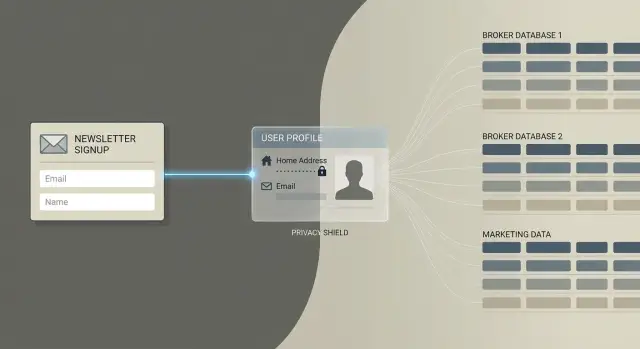
One email can lead to a full profile
A signup form looks harmless. You type an email address, maybe tick a box, and move on. It feels like a tiny exchange.
But the record rarely stops at the email itself. Sites often log the time of signup, your device and browser, a rough location from your IP address, and the page or ad that brought you there. None of that tells a full story on its own, but together it gives the record more shape.
Email also sticks. People keep the same address for years and reuse it across stores, newsletters, receipts, apps, and giveaways. One company may only see a small slice of that history. Data brokers make a business out of joining those slices together.
That is the basic idea behind email append services. A company or vendor can compare a new signup against much larger files that already hold names, past addresses, household links, age ranges, and marketing tags. If that email has shown up elsewhere before, even in an old purchase file or broker database, the match can be easier than most people expect.
Once a likely match is made, the record can fill out fast. A name may be added first, then a street address, ZIP code, and details tied to the same household. What started as one email can turn into one of many data broker profiles built from linked records.
That is why people are often surprised by what sits behind a basic form. You may remember sharing one detail, but brokers work by connecting fragments. An email plus device clues and rough location can be enough to narrow one person down to one home.
The match is not always right, and errors do happen. Still, when several signals line up, one short signup can become a much fuller record than most people expect. That is a big reason personal data removal matters.
What append means in plain language
"Append" is just a data word for adding missing details to a record that already exists.
Say you sign up for a newsletter with your email address, or you buy something and leave an email at checkout. That email may be the only thing a company has at first. An append service tries to turn that thin record into a fuller one.
This is where email append services come in. They take the email address and compare it with outside databases that may already tie it to a name, a past purchase, a mailing address, an age range, household details, or other bits of information linked to the same person.
The process is basically a matching job. The service looks for records that seem to belong to the same person by comparing clues such as the email itself, a name on the order, a city, a phone number, or other account details. If enough of those clues line up, the service adds the new details to the original record.
That does not mean the company suddenly knows everything about you. It means the record got a lot less empty. A signup with only "[email protected]" can become "Jane Doe, likely lives at this address, part of this household, interested in these products."
Once that happens, the fuller profile can be used to send postal mail, aim ads at a household, sort people into marketing groups, or feed a larger broker database. Append does not create a person out of nowhere. It fills in blanks around someone a company already has some way to identify.
That is why a small action, like entering an email into a form, can lead to a much bigger profile than most people expect.
What a company may already know
A company usually does not start with just your email. By the time email append services enter the picture, there is often already a small pile of details tied to that address. A newsletter signup, a quote form, or a checkout page can reveal more than most people think.
The obvious part is what you typed in yourself. That might be your email, first name, phone number, ZIP code, or shipping address if you bought something. Even a short form can give enough to make a decent guess about who you are.
There is also information created by the visit itself. Your IP address can suggest a rough area, sometimes down to a city. The site may also log the time of visit, device type, browser, and whether you came back later from the same network.
If you have dealt with the company before, the record gets thicker. Old orders, returns, support emails, warranty claims, and abandoned carts often sit under the same email address. A support request that mentions a new phone number or a move to a different city can quietly update the file.
Many companies also bring in outside data. They may upload customer lists from another brand they own, buy a marketing data append file, or match their list against a partner database. That can add an age range, household income band, likely home ownership, or a possible street address, even if you never typed those details into the site.
The email address matters because it is a strong anchor. People change devices and clear cookies, but many keep the same main email for years. Once that address appears in several places, separate bits of information start to look like one person instead of random scraps.
A simple example makes the point. Emma enters her email for a 10 percent discount, adds her first name, and later asks support about a delayed order. The company now has an email, a name, a product interest, a purchase history, a phone number from the support form, and a rough location from her visits. That is already enough for a broker or matching vendor to test against other records and fill in the blanks.
This is why personal data removal is rarely about one form or one site. Small pieces from different places can join up fast, and the email address is often the thread that ties them together.
How the match happens, step by step
The matching process is less dramatic than it sounds. In most cases, it starts with a plain signup form and a cleanup pass so the data is easier to compare across many files.
A company or broker will first normalize the record. That means putting the email in one standard format, fixing spacing, splitting full names into first and last name, and turning addresses into the same postal format. Small differences matter. "Jane A. Smith" and "Jane Smith" may be the same person, but a machine often needs help seeing that.
Next, the email becomes a lookup value. Sometimes it stays in plain text inside the company that collected it. Sometimes it is turned into a hash, which is a coded form used to compare records without showing the raw email at every step. That sounds safer than it is. If another file uses the same method, the hash can still work like a bridge.
Then comes the actual comparison. Email append services check that lookup value against large data sets such as broker files, old customer lists, change-of-address records, and address history databases. They are not always looking for one perfect match right away. They are looking for overlap.
A system might give more weight to an email that appears with the same full name in another file. It might also look for a matching surname and ZIP code, the same phone number, a past shipping address tied to the email, or an age range and city that fit the rest of the record. Each signal adds or subtracts confidence.
If enough details line up, the system attaches the most likely home address and may add other fields too, such as household members, move dates, or property details. If the score is weak, the record may stay partial or get checked again later.
That last part matters because these profiles do not sit still. When new data shows up, the system can recheck a record and fill in blanks it could not confirm before. A signup from six months ago might match cleanly today because a new retailer file, warranty card, or broker update added one more point of agreement.
This is how one email can become a fuller profile over time. The first pass may only guess. Later passes often get closer.
Where the added details usually come from
The extra details usually do not come from one dramatic leak. More often, they come from years of ordinary forms, purchases, and list sharing. That is what makes email append services unsettling. A single signup can be matched against records collected long before you typed your email into a box.
One common source is old marketing data. Stores, catalog brands, sweepstakes pages, quote forms, and newsletter popups have collected names, emails, mailing addresses, and phone numbers for decades. Even if one company only has part of the puzzle, that record can still be sold, rented, or shared with a broker that combines it with other files.
Another source is the broker market itself. Many brokers do not gather everything firsthand. They buy records, trade updates, and merge files from other brokers. One file might have an email and ZIP code. Another might have a full name and street address. If enough fields line up, those pieces can become one profile.
Offline habits matter too. Warranty cards, rebate forms, survey entries, loyalty signups, and event registrations have fed this system for years. People often filled these out casually, sometimes long ago, without expecting the data to keep circulating. That older paper trail can still appear in modern marketing data append records.
Property records and address history files also play a part where they are public or easy to buy. Home purchases, moves, voter records in some places, and change-of-address datasets can help brokers connect a person to a current or past address. Once one broker updates that address, others may copy the change.
The pattern is simple. A retailer has your email from an online order. A list seller has your name and mailing address from a past catalog signup. A broker matches both records on name, ZIP code, or household details. Then the updated profile gets passed around again.
That final step is what makes the problem hard to clean up. Broker profiles are not static. When one record changes, the update often moves through other databases too. That is one reason personal data removal takes ongoing work instead of a single request.
A simple example of a signup turning into a broker record
Picture a normal online signup. Anna wants a 15 percent discount code from a clothing store, so she enters her personal email, her first name, and her ZIP code. She does not type her street address, phone number, or date of birth.
That can still be enough for a likely match.
A company handling marketing data append takes Anna's email and checks it against older records it already has. Maybe that same email showed up years ago on a purchase shipped to a home address. Maybe it appeared in a warranty form, a loyalty account, or a past order from another retailer. On its own, the email might be old or messy. The first name and ZIP code help narrow it down.
Now the broker can see a pattern: the email matches an older file, the name fits, and the ZIP code points to the same area as a past address. That does not prove the match with perfect certainty. But if the records all lean toward one household, the broker may treat that address as the best guess.
Once that happens, the profile grows. Anna's signup can be updated with a street address, city, state, and other household facts already tied to that home. That may include an age range, whether the home is rented or owned, who else may live there, and shopping categories linked to the household.
This is why privacy advocates worry about email append services. A person thinks, "I only asked for a coupon." The broker may read that small signup as a fresh signal that an older record is still active and still belongs to the same person.
The result is a fuller broker record built from tiny pieces. One email, one first name, and one ZIP code can be enough to reconnect a person to a home address that they never typed into that form.
Where matches go wrong
Matching systems sound precise, but many of them run on probability, not certainty. A broker may see the same email, part of a name, or an old postal record in a few places and decide it all belongs to one person. Sometimes that guess is right. Sometimes it is badly wrong.
A common problem is the shared household email. Families still use joint inboxes for school forms, coupons, or home services. If one person signs up with it, the match can pull in details for a spouse, parent, or adult child at the same address. One inbox can turn into a mixed record.
Moves create another mess. A person may keep the same email for ten years while changing homes several times. If a broker has stronger history for the old place than the new one, the old address may win the match. That means a recent signup can get tied to a house someone left long ago.
Small errors matter more than most people expect. A typo in a last name, street number, apartment number, or ZIP code can push a record to the wrong household. This happens a lot in apartment buildings and in neighborhoods with similar street names. Once a bad match lands in one file, other companies may copy it.
Work data adds more confusion. Reused work emails, shared inboxes, and recycled phone numbers can all blur identity. A phone number that belonged to one employee last year may belong to someone else now. If both records stay in the system, the match can blend them together.
Some firms also accept weak matches on purpose because they want larger lists. Clean data takes more effort. Bigger marketing files are easier to sell, even when some records are only "close enough."
That is why email append services can feed inaccurate data broker profiles. If you find an old address, a relative's details, or a stranger's phone number attached to your name, it may not be some deep mystery. It may just be a sloppy match that kept spreading.
A quick check for your own exposure
A fast self-check can tell you a lot. Start with one question: how often do you use your main personal email for store discounts, giveaways, loyalty programs, online coupons, and casual signups?
If the answer is "almost every time," your exposure is probably higher. Email append services work better when one email shows up across many forms, purchases, and mailing lists.
A few signs are easy to spot. You may have started getting paper mail after filling out online forms for coupons or special offers. A people-search site may show your name and home address together. Old addresses, relatives, or phone numbers may appear next to an email you still use. Or the same inbox may be tied to shopping, newsletters, rewards programs, and one-time signups.
That paper mail clue matters more than people think. If junk mail picks up soon after an online signup, there is a good chance your details moved beyond that one company.
Do a quick search for yourself on a few people-search sites. Try your full name plus city, then your full name plus home address. If you find a match, you are likely already sitting inside one or more broker profiles.
You can also lower future exposure with two boring but effective habits. Keep one email for friends, banking, healthcare, and bills, and use a different one for promotions or throwaway discounts. And leave optional fields blank unless you really need the offer. Many forms ask for a phone number, street address, or birth date when they do not need it to send a coupon.
This will not erase records that already exist, but it can slow down new matching. That matters because email to home address matching gets easier when forms are complete and the same email keeps appearing everywhere.
What to do next
If this feels a little creepy, the fix is usually boring too: clean up old signups, opt out where you can, and keep checking. Email append services work best when your old accounts, promo forms, and newsletter signups stay active for years.
Start with the places you forgot about. Think store discounts, sweepstakes entries, old apps, loyalty programs, and mailing lists you joined once and never touched again. If you no longer use them, close the account or change the email address if the service allows it.
A simple routine helps. Search your inbox for welcome emails, discount codes, and old newsletter confirmations. Make a short list of accounts and mailing lists you do not need anymore. Then delete those accounts, unsubscribe, or strip out extra profile details like your phone number and home address. After that, opt out of major data broker and people-search sites that already list you.
That step matters because once a broker has matched your email to a name and address, the record can spread. One opt-out is better than none, but it is rarely the end of it.
Re-listings are common. A broker may pull fresh data from another source a few weeks or months later, and your profile shows up again. Set a reminder to check the same sites instead of assuming the first request fixed everything.
A small example shows why. If you used one email for online shopping, a pizza coupon, and a rewards app five years ago, that single address may have been copied into several marketing files. Closing one account does not erase the copies already sold onward. You have to work on both sides of the problem: the original signups and the broker listings.
If you have the time, manual opt-outs can work. They are just slow, repetitive, and easy to lose track of.
If you would rather not chase each broker yourself, services like Remove.dev can handle a lot of that work. Remove.dev removes personal data from over 500 data brokers worldwide, monitors for re-listings, and lets you track requests in a dashboard. Most removals are completed within 7-14 days, which is a lot easier than checking each site by hand.
The practical goal is simple: give brokers less to match, remove what is already out there, and check again before the same record comes back.