Genealogy websites and privacy: how relatives get exposed
Genealogy websites and privacy matter more than many families expect. Family trees, memorial pages, and kinship clues can expose current households.
Why deceased records still expose living people
A page about someone who died can still expose people who are very much alive. That is the uncomfortable part of online family history. An obituary, memorial page, or old family record may look harmless because the person at the center of it is gone. But those pages often name a spouse, children, siblings, in-laws, and grandchildren. One deceased relative's record can become a map of a living family.
Sometimes the exposure is obvious. A notice might say, "survived by his wife Anna, son Michael of Phoenix, daughter Lisa Carter of Tempe, and sister Denise Hall." That one line gives full names, relationship links, a married surname, and recent cities. For a data broker, that is often enough to start matching living people across other databases.
Small details narrow the search faster than most families expect. A rare last name, one city, and one relative's married name may be all it takes. Add the funeral home, church, cemetery, or hometown, and the pool gets even smaller. Brokers do not need one perfect source. They need a few details that fit together.
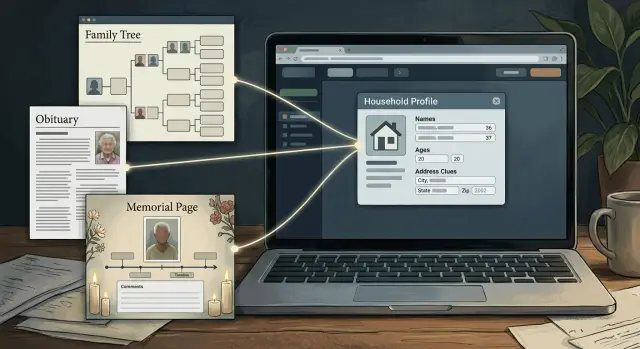
The problem grows when the same family data appears in several places. An obituary names the children. A memorial page copies the obituary. A family tree adds parents and siblings. A people-search site then connects those names into a household profile or a list of likely relatives. Each page shows only part of the picture, but together they can say a lot.
That is why old records are not really old in any practical sense. A page published years ago can still help someone figure out where a living daughter moved, which surname a son uses now, or which relatives probably share the same address. One mention of family on a deceased person's page can keep exposing the living long after the funeral is over.
How family trees fill in the blanks
A public family tree does more than show the past. It puts grandparents, parents, siblings, spouses, and children in one place. For a data broker, that saves a lot of guesswork.
The details do not have to be perfect. They just have to line up well enough. When several generations appear on one tree, the missing parts between old records and living relatives get much easier to fill in.
Maiden names matter a lot here. A woman may appear under one last name in a school record, another in a property file, and her birth name in a family tree. Once those names connect to the same parents, records that looked separate can be tied to one person.
Birth years also help narrow things quickly. If a broker already has a city, an age range, and a phone number from somewhere else, a tree with a full birth year, or even a rough one, can shrink the list of possible matches to a handful.
Location patterns matter too. Many families stay in the same town, county, or metro area for decades. When a tree shows the same place across parents, children, and grandparents, it becomes easier to place the family and look for current addresses nearby.
One public tree can quietly confirm who is related to whom, which maiden and married names belong to the same person, which age range fits a living relative, and which places repeat across the family. That is when the privacy risk becomes real. Brokers often start with a rough guess built from scattered records. A single public tree can confirm the relationship pattern they were only guessing at.
Picture a tree that lists a deceased grandfather, his two daughters, one daughter's maiden name, and the city where the family lived for years. The daughters may not show their current homes on the tree. Even so, the relationship map is already there. Match that against people-search records or property data, and the present-day household becomes much easier to identify.
A family tree may look like harmless history. In practice, it can connect old names to living people with surprising ease.
What memorial pages give away
Memorial pages look harmless because they focus on someone who has died. In practice, they often expose the people who are still alive.
A typical obituary does more than announce a death. It may name a spouse, children, grandchildren, siblings, and in-laws, often with full names. If one line says "survived by his wife Susan Miller, son Jason Miller and daughter Erin Cole," you already have a small family map.
These pages usually add local facts too. A town name, church, cemetery, funeral home, or service location can narrow the family to one area fast. For a data broker, that may be enough to connect names to address records, age ranges, and household profiles.
Guestbooks can make things worse. People sign with both first and last names, mention where they live, or write notes like "your cousin in Dayton." Some add workplaces, schools, or how they knew the family. Those small details help confirm that two people with common names are the right match.
Photos add another layer. A caption such as "Tom and Linda at their 40th anniversary" or "the Smith kids in 2008" can confirm a spouse, identify adult children, and suggest rough ages.
In plain terms, memorial pages often hand over full names of living relatives, city or county clues, relationship details across several generations, public comments that add local context, and photos or captions that confirm identity.
The problem does not fade quickly. Old obituaries and memorial pages can stay indexed and searchable for years. Once copied into people-search sites or broker databases, the trail gets harder to clean up.
If your family has ever posted memorials online, try searching a few names together with a town or funeral home. One old page may still say far more about the living than the dead.
How brokers build current household profiles
Data brokers rarely find a full family picture in one place. They build it by stitching together names, age ranges, old addresses, memorial pages, public records, and people-search data until the gaps are small enough to fill.
A page about someone who died years ago can still help sort out who is related to whom right now.
A common pattern starts with a deceased relative. An obituary or memorial page lists a spouse, children, siblings, and a town. The broker then checks other records that already contain likely matches, such as age bands, address history, and known relatives. If two or three details line up, the match becomes much more convincing.
What usually matters is not one dramatic fact but a cluster of signals: the same surname in the same city, age ranges that fit family roles, past addresses shared with parents or siblings, relationship labels such as wife or granddaughter, and nearby addresses that suggest a move rather than a broken link.
Family roles matter more than most people realize. If one record says "Michael Reed, 67" lived with "Karen Reed," and an obituary says the deceased was survived by husband Michael and daughter Karen, the connection gets much stronger. Once one person is verified, several others often fall into place.
Household data works like a chain. Confirm a parent, and you may also confirm a spouse. Confirm the spouse, and then children, old home addresses, and likely current neighbors start to fit together. One solid link can make an entire profile look current.
That is why an obituary from five years ago can still help a broker choose the right household today. If newer records show the same family names, the same area, or a move from one known address to another, the old page still has real value.
For brokers, old family records are shortcuts. They turn scattered facts into a household profile that feels current enough to sell, search, or copy into the next database.
A simple example from one obituary
This gets real very quickly. One short obituary can give away enough clues to point straight to living relatives.
Picture a notice for a deceased man that says he was survived by his widow, two sons, and a daughter. It includes the family town and the name of the funeral home. That seems ordinary. Many families post details like this without thinking twice.
Now add a public family tree. The widow's maiden name appears there, along with rough birth years for the children and the daughter's married name. Suddenly the record is much easier to match to people who are alive today.
A broker does not need every detail to be exact. A widow's full name, a small town, and two adult sons with matching age ranges can be enough to narrow thousands of records down to one household.
The funeral home matters too. It can confirm the county, spellings, and the same relative names shown in the obituary. If the broker already has older address data, that extra confirmation can connect the family to one current address with high confidence.
The finished profile can look uncomfortably complete. It may show the widow at a current home address, list one son as another resident or recent contact, attach past addresses, and name the daughter under her married surname as a likely relative. Sometimes phone numbers and email addresses get attached too.
Nothing in that chain required a hacked account or a Social Security number. It came from small public clues that fit together cleanly.
That is the real problem. One obituary honors a deceased person, but the surrounding records can expose an entire living family.
How to check your family exposure step by step
The fastest way to spot exposure is to follow the same trail a broker would follow. The problem is rarely one page by itself. It is the way old records connect to current names, addresses, and households.
Do it in one sitting if you can. Search results change, and memorial pages or broker listings sometimes update without warning.
Start with a full name, then add a city or state and one relative. Search combinations such as a parent plus an adult child, or a married couple plus a town. That often pulls up family trees, obituary pages, and people-search results faster than a name alone.
Open four kinds of pages first: family trees, obituaries, memorials, and broker listings. Trees often reveal relationships and birth years. Obituaries and memorials usually name spouses, children, siblings, and the city where they lived.
As you go, write down the details that repeat. Focus on addresses, approximate ages, spouse names, adult children, and unusual last names. If three different pages show the same daughter, the same town, and the same age range, that is enough for a broker to connect the dots.
Then compare older family records with current broker listings. An obituary from 2018 might list "survived by son Michael and daughter Erin in Phoenix," while a people-search page today shows Michael, Erin, and their mother tied to one current address. That is how a deceased relative can point straight to a living household.
Save screenshots and the date for every page you find before you request removals or privacy edits. Pages get updated, merged, or taken down, and you may need proof later if the same details show up again.
If you want to be thorough, keep a simple note for each person in your family: which page exposed them, which detail linked them, and whether that same detail now appears on a broker site. That turns a messy search into a manageable cleanup plan.
What to remove or hide first
Start with the details that make matching easy. The biggest problem is usually not one dramatic fact. It is a cluster of small facts sitting together: a full name, an exact birth date, a relationship, and a place.
If you have a public family tree, hide every living person first. Most sites let you mark someone as living so the profile stays private. Use that setting even if the tree feels harmless. A broker does not need a full profile if the relationships already point to the right household.
Then trim the details that make a name easier to match. Exact birth dates are a common one. So are middle names, maiden names, and suffixes. If a site allows it, leave only the birth year for deceased relatives and remove middle names for living relatives.
Memorial pages need the same treatment. Obituaries and tribute posts often include street addresses, apartment numbers, and city-level details that never needed to be public in the first place. Cut those lines first. A sentence like "family and friends may visit at 1142 Pine Street" gives away far too much.
The wording around surviving relatives matters too. Keep it general when you can. "Survived by two daughters and a son" is safer than listing full names and locations. If names are necessary, skip middle names, married names, and phrases such as "of Dallas" or "residing at" for living relatives. Check guestbook entries and tributes too, not just the main obituary text.
One problem many families miss is copied text. A funeral home notice may get reposted to memorial sites, local archives, and hobby genealogy pages. If you fix the original but leave the copies up, the trail stays open. Ask each site owner to edit or remove the copied obituary text, especially the parts that name living relatives or include address details.
A good rule is simple: leave enough to remember the deceased, but not enough to map the living.
Mistakes that keep the trail open
One of the biggest mistakes is assuming a page about someone who has died cannot affect the living. In practice, a memorial page or obituary often names a spouse, children, siblings, and grandchildren. That turns a dead-end record into a family map.
Another common mistake is leaving one public family tree open as the main family record. Even if most of your research stays private, that one open tree can connect names, birth years, towns, and relationships in a way brokers can use immediately.
People also post the same obituary text on several websites. That feels harmless, but it makes the data much harder to control. If one site removes the page and three others keep it, the trail is still there. Repeated wording also makes matching easier when brokers or scraper sites compare records.
Naming minors and adult children in full is another easy slip. A line like "survived by John and Lisa Smith and their children Emma and Noah" gives away a lot in one sentence. It links generations, suggests an address cluster, and can confirm a maiden or married name.
A short self-check helps. Keep your main family tree private unless you have a clear reason to open it. Avoid posting full obituary text on multiple sites. Use initials or general labels for children and grandchildren when possible. Recheck older pages after edits, because copied versions may still exist.
The last mistake is trusting an edit to erase the record. It often does not. Broker sites, archive pages, and scraper databases may keep an older copy long after the public page changes.
If you clean up one page, search for the same names and wording elsewhere. That extra ten minutes can close a trail that would otherwise stay open for years.
A quick privacy checklist
Small details matter more than most people expect. A public tree or memorial page does not need to show a full address to expose a current household. A name, a town, a spouse, and a child can be enough.
Use this as a fast review before you publish anything new and when you revisit older pages:
- Mark every living relative as private or visible only to approved family members.
- Remove exact street addresses from memorial pages, obituaries, guestbooks, and photo captions.
- Show only a birth year, or nothing at all, for living people.
- Rewrite surviving-relative lines in a less specific way.
- Save screenshots before and after edits so you have a record if you need to ask for removal later.
One small edit can close a big gap. Changing "survived by Michael and Sarah Johnson of 18 Maple Lane, Denver, with children Emma and Noah" to "survived by Michael Johnson and family" removes several clues at once.
Memorial pages need extra care because they often stay online for years and get copied into archives and data sets. If an exact address or full date was posted once, take a screenshot, request the change, and then check again a week later.
Family trees need the same habit. Private settings sometimes apply only to profiles marked as living, so look for relatives who were entered by mistake as deceased or left with public notes attached.
If you want one simple rule, use this: for living people, keep public pages limited to names only when necessary, broad location at most, and no exact dates, no street details, and no household roll call.
What to do next
Start where the spill is biggest. In most cases, that means family tree pages, obituary reposts, and memorial pages that name children, siblings, spouses, and towns. If one page ties a deceased person to several living relatives, fix that page first.
Work in order rather than trying to clean up everything at once. Pick one relative name and follow the trail. If the same surname, age range, city, or old address keeps showing up, you have found the pages most worth fixing.
Save the pages that list the most living relatives. Ask genealogy and memorial sites to edit, hide, or remove those details. Then search broker sites for the same names, ages, addresses, and known associates. Keep notes so you can see what disappeared and what came back. A few weeks later, run the same searches again.
Do not stop after one removal request. Brokers copy from each other, and they also pull from older snapshots. If a memorial page is cleaned up but a broker profile still shows the same daughter, spouse, and street name, that copied record needs its own removal request.
This is the part many people abandon because manual cleanup takes time. If you do not want to send dozens of requests yourself, Remove.dev can handle removals across more than 500 data brokers and keep monitoring for re-listings. It is a practical way to deal with the copies that remain after you edit the original family pages.
What matters most is follow-through. Make the first edits, check which broker profiles still match them, and then search again in a few weeks. When the same names stop appearing together, you have started to break the chain that exposes living relatives.