Moving to another state privacy: what changes for removals
Moving to another state privacy rules can change what brokers collect, which records appear, and how you handle removals after a new address goes live.
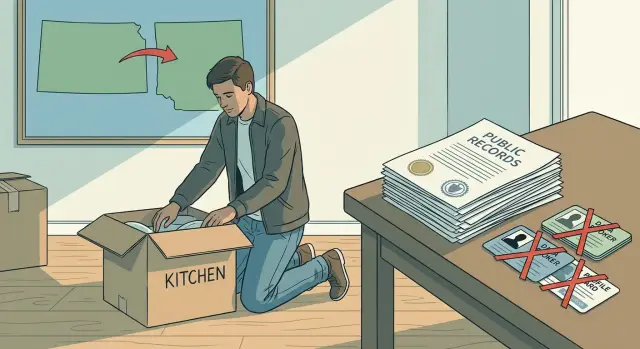
Why a move makes old data show up again
A move gives data brokers fresh material. Your new address can show up in change-of-address files, utility signups, rental applications, property records, voter rolls, court systems, and other databases that feed people-search sites. Each source may look small on its own, but together they create a new trail.
That's why an old removal doesn't always stay finished. A broker might delete one profile tied to your previous address, then build another when your new address appears somewhere else. To the site, that can look like a brand-new record rather than a return of the old one.
Most brokers don't keep one clean file per person. They piece together scraps of data: your name, age range, phone number, email, relatives, and past addresses. If enough of those details match, they connect the old and new records quickly. One move can merge two versions of your identity into a larger profile instead of replacing the old one.
Search results can reset too. When a new listing goes live on a people-search site, search engines may crawl it and index it as a fresh page. So even if you spent time clearing older results, a new address can push new pages into search within days or weeks.
This is where many people get caught. They remove one listing, search their name once, and assume the job is over. Then another broker publishes the same person with the new address, or the same broker posts a second version with a slightly different spelling, middle initial, or phone number.
A simple example helps. Say you move from Arizona to Colorado, update your license, start electric service, and sign a lease. A broker can link your old Arizona address to the new Colorado one and republish both. Suddenly, someone searching your name may see more information than before.
After a move, removals work best as an ongoing check rather than a one-time sweep.
What usually follows you across state lines
A move feels clean on your end. For data brokers, it often looks like one more layer added to an old profile.
Your old addresses don't disappear when you rent a new place, change your license, or set up utilities. They stay tied to your name for years, and many people-search sites stack them together. A search for you might show your old apartment, your current city, and a few guesses in between.
Phone numbers and email addresses make this much easier. If you keep the same mobile number after moving, brokers use it to connect the old record to the new one. The same goes for an email you've used for job applications, shopping accounts, or moving quotes.
Even small details can be enough to join records that look separate at first. A site may not know your exact new address yet, but your old cities, age range, long-used email address, and unchanged phone number can still produce a very close match.
Relatives and household members can expose the new address too. If your spouse, parent, sibling, or roommate appears in public records or on a broker site, your profile may update through that connection. This often happens after a home purchase, voter registration update, or shared utility account.
That's why moving to another state privacy issues can feel oddly personal. You may do everything right, but someone else in your household updates a record first, and your new location starts spreading.
Picture this: you move from Arizona to Colorado and keep your phone number. A broker already has your old address, age range, and your sister's name from a past listing. Your sister updates her voter record, and another people-search site adds your new city because it sees the family link and the same phone number. Two profiles that looked old now point to your current area.
How state rules change the work
A move changes more than your address. It changes which rules apply, which records get created, and how easy it is to get your data taken down.
With moving to another state privacy, the biggest shift is your legal footing. Some states give you a clear right to ask a company to delete your data or stop selling it. Others offer less, so removal depends more on each broker's own process. That usually means more forms, more follow-up, and more waiting.
Proof rules vary from company to company. One broker may accept a masked ID and a utility bill. Another may ask for a full ID, a selfie, or a signed statement. After a move, that gets messy fast because your old address and new address may both appear in broker files. If the records don't line up, the request can stall even when you're obviously the right person.
Response times are uneven too. Some privacy laws set deadlines. Some don't. Even when a deadline exists, the clock may start only after the company says your identity is verified.
Public records are the other major limit. A broker can remove your profile, but a government record may still stay public if local law allows it. The broker listing disappears, then comes back later because the source record is still open.
Buying a home often makes this worse. A deed, tax record, or mortgage filing can create fresh public entries in a new county. Renting usually leaves a smaller public trail, though tenant screening data can still spread.
Three things usually control the job: the privacy law in your new state, the broker's own verification rules, and the public records that remain open in your new county.
Which records often appear after a move
A move creates a fresh paper trail. Even if you cleaned up old people-search sites, new records can feed them again. The trouble often starts with government and licensing databases, not with the broker sites themselves.
Property records are one of the first places your new address can appear. If you buy a home, the deed, county recorder page, and tax assessor record may list your name, the property address, the sale date, and sometimes a mailing address too. In some counties, these pages are easy to search and easy for brokers to copy.
Voter registration can expose more than people expect. Some states keep voter data fairly locked down. Others allow public access to parts of the record, such as your name, address, precinct, or party registration. A simple update after a move can become a new source for brokers.
Court records are another common source. Your new county may publish civil filings, traffic cases, probate matters, or landlord-tenant disputes online. Even a minor case can connect your full name to a current address, a past address, a family member, or an employer.
If you hold a professional license, check that too. Nurses, contractors, real estate agents, and many other licensed workers often appear in public databases. Some boards show only a city. Others show a full street address unless you switch it to a business address or another allowed mailing address.
If you work for yourself, business records can be just as revealing. State corporation searches, DBA filings, and local business licenses may display an owner name and home address. This happens a lot with single-member LLCs and sole proprietors who file quickly and use whatever address is handy.
A good first pass is to check county deed and tax pages, voter registration rules, county court search portals, state license lookup pages, and state or local business registries. Those sources often explain why a new broker listing appeared in the first place.
What to do in the first 30 days
The first month after a move matters more than most people think. This is when old and new details start getting tied together across broker sites, people-search pages, and public records. Catch those links early, and removal work is usually faster.
Start with one plain document. Write down every address tied to you, not just the place you left and the place you moved to. Include apartment numbers, ZIP codes, and any variations you've used before. A broker may list "Unit 4B" on one page and "Apt 4B" on another, and both can point to the same profile.
Next, search your name in a few combinations. Try your full name with your old city, then your new city, then each ZIP code. Search your phone number and email too. If you have a common name, those extra details help you find the right records instead of wasting time on someone else's page.
Before you send a removal request, save proof. A screenshot with the site name, your listing, and the date is usually enough. It feels tedious, but it saves time later. If a site claims the page is gone when it's still live, or if the same record comes back, you have something concrete for follow-up.
A simple first-month routine works well:
- Build your address and contact list first.
- Search using your name, city, ZIP, phone number, and email.
- Save screenshots before each opt-out.
- Send requests in small batches so they're easier to track.
- Check the same sites again after 2 to 4 weeks.
Small batches beat sending fifty requests in one night. Ten to fifteen at a time is easier to manage, especially when some sites ask for email confirmation and others ask for more documents.
When you recheck after a few weeks, look for small changes, not just full removal. A page may drop your street address but still show your old city and phone number. That can still give brokers enough to reconnect the record, so it's worth sending one more request.
A simple example of one move
Picture a renter leaving Ohio for North Carolina. They sign a new lease, set up utilities, and update a few accounts. Within days, that fresh address starts moving through the usual places: credit headers, utility files, marketing databases, and people-search sites.
One people-search site picks up the new lease address and connects it to an old cell number from Ohio. Now the profile looks fuller than before. It has the old number, the new city, and enough matching details to make the record easy to find.
The person sends a removal request for the main listing. A few days later, the site takes it down. Problem solved? Usually not.
About a week later, another broker copies the same record from a cached source or a partner feed. That second listing may not look identical. Maybe the street name is shortened, or the phone number is partly hidden. It still points to the same person.
This is why one-time removal is often too thin after a move. You remove the first profile, then watch for copies, relistings, and merged records that show up later.
The example changes if the move includes buying a home instead of renting. A lease can leak into broker databases quickly, but a home purchase can create a county-level public record that lasts much longer. Once that record is indexed, more brokers can pull from it.
So the real job isn't just removing one page. It's tracking how the new address, old phone number, and public record trail start to connect after the move.
Mistakes that slow removals
A move creates more versions of you online than most people expect. Old addresses, new addresses, nicknames, and half-matched profiles can all get mixed together. That's why data broker removal after moving often stalls for simple reasons, not legal ones.
One common mistake is searching only one version of your name. If a broker lists "Jen Miller," "Jennifer Miller," and "Jennifer A Miller," those may appear as separate profiles. Add maiden names, middle initials, and common misspellings, and it's easy to miss half the listings.
Old apartments get forgotten all the time. People remember the house they owned for five years, but not the six-month sublet, student housing, or short-term rental they used between jobs. Those smaller stops still end up in people-search sites and public record databases, and they often reconnect your old state with your new one.
Another slowdown is ignoring shared listings. If you lived with a spouse, partner, parent, or roommate, your details may appear inside their profile too. Even if your own page gets removed, your phone number or address can stay visible through someone else tied to that address.
Stopping after one round of opt-outs is another big problem. Many sites republish data after a few weeks because they buy fresh records, scrape other sources, or rebuild profiles from linked people. After a move, one request is rarely enough. The first pass removes what's visible now. The next pass catches what came back.
Poor evidence slows things down too. A blurry screenshot, cropped page, or missing page details gives the site very little to work with. If you're sending requests yourself, include the exact name shown on the listing, the full address or at least the city-state pair on the page, a clear screenshot, the page title or profile ID if the site uses one, and any related household names shown nearby.
The fastest removals usually come from patient, repetitive work. Check every name variation, every old address, and every shared household record before you decide a listing is gone.
Quick check before you call it done
A move feels finished once the boxes are unpacked. Your data is usually a few weeks behind. Before you stop checking, make sure the old trail is actually gone and the new one isn't forming.
Run a few plain searches using your full name, old city, old address, new city, and phone number. Check the first page or two of results, not just the top result. You want the major people-search and data broker sites to stop showing your old address.
Then look for a more annoying problem: your new address getting tied to your phone number. That pairing spreads fast once one broker posts it. If you spot both together, send removal requests early before smaller sites copy it.
A quick review should cover five things:
- Your old address no longer appears on major broker listings.
- Your new address is not listed next to your phone number.
- Search results do not connect you to other people at the new home unless that record makes sense.
- You know which public records can stay visible and why.
- You have a date set for the next review.
That third point matters more than people expect. After a move, search results may start grouping you with a spouse, roommate, parent, or even a prior resident at the new place. Sometimes that comes from voter rolls, property records, utility data, or simple broker guesswork.
Some records won't disappear. Property deeds, court filings, and business registrations may stay public under state privacy laws and public record rules. The goal is to know what can be removed from broker sites and what will remain as an official record, so you don't waste time chasing the wrong thing.
Set your next review date before you close the tab. Thirty days is a good first check, then every few months after that.
What to do next
After a move, don't treat one cleanup pass as the end. Data brokers copy each other, and some sites repost old details a few weeks later. With moving to another state privacy issues, the real job is follow-up.
Start with a short watchlist. Keep the names of the sites that showed your old address, new address, phone number, age, or relatives. You don't need a giant spreadsheet. A note on your phone or a basic tracker is often enough as long as you update it.
A simple tracker only needs four pieces of information: the site name, what data appeared, when you sent the request, and the current status or removal date. That small habit prevents a common problem: forgetting which sites were cleared and which ones came back.
Recheck after any big life change. A move is the obvious one, but marriage, a home purchase, a name change, or setting up utilities can create new records fast. For most people, a quick review once a month for the first few months works well.
If you want less manual work, Remove.dev can remove personal data from more than 500 data brokers and keep checking for re-listings. That's useful after a move, because the same record can come back weeks later under a slightly different version of your name or address. You can also track each request in real time in the dashboard.
A simple rule works well: keep your list short, check again after major changes, and don't assume a site stays clean forever. A few minutes of follow-up now can save hours later.
FAQ
Why did my personal info come back after I moved?
Because a move creates fresh records. Your new address can appear in utility files, lease or deed records, voter data, and other databases that people-search sites copy. A broker may treat that as a new profile, even if you removed an older one before.
What details usually tie my old address to my new one?
Usually it is your phone number, email, age range, relatives, and past addresses. If those details stay the same, brokers can connect your old record to your new location very quickly.
Does moving to another state change my privacy rights?
Yes, sometimes a lot. Your new state may give you stronger deletion or opt-out rights, or it may leave more to each broker's own process. Even with a clear law, a company may still ask you to verify your identity before it acts.
Which records are most likely to expose my new address?
Home purchase records, tax assessor pages, voter registration, court records, professional license lookups, and business filings are common sources. If one of those is public in your new county or state, brokers can copy it later.
What should I do in the first 30 days after a move?
Start by writing down every address variation tied to you, including apartment numbers and ZIP codes. Then search your name with your old city, new city, phone number, and email, save screenshots, and send opt-out requests in small batches.
Should I focus on old listings or new listings first?
Begin with whatever is visible and easiest to confirm. In practice, that means removing both old and new listings when you find them, because the old record can still help brokers rebuild the new one.
Why do broker listings come back after I opt out?
Brokers often buy fresh data, scrape other sources, or rebuild profiles from linked people. So the first removal may clear one page, but another version can appear days or weeks later with small changes in spelling, address format, or phone details.
Can my family or roommate expose my new address?
They can. A spouse, parent, sibling, or roommate may update a public record first, and that can help a broker connect you to the new address. Shared utility accounts, voter records, and property records are common ways this happens.
How often should I check for relistings after I move?
A good default is to check again in about 30 days, then every few months. You should also recheck after another big change like a home purchase, marriage, name change, or a new business filing.
Is a removal service worth it after moving to a new state?
If you want less manual work, a service can save time after a move because relistings are common. Remove.dev removes data from over 500 brokers, monitors for re-listings, and sends new requests automatically. Most removals finish in 7 to 14 days, and you can track requests in real time through the dashboard. Plans start at $6.67 per month and include a 30-day money-back guarantee.