Old usernames expose personal details across the web
Old usernames expose personal details when forum archives, cached pages, and reused handles connect old posts to your real name, email, or address.
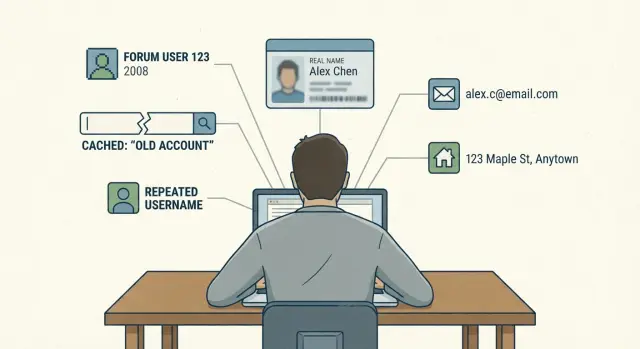
Why an old username matters
An old username can look harmless. It might feel like a leftover from a forum you stopped using years ago. But once the same handle appears on more than one site, it starts to act like a label that ties those accounts together.
Search engines can keep those names visible for a long time. Forum archives often stay public long after a site feels abandoned. Even a profile you deleted can still appear in reply quotes, copied pages, scraped databases, or cached search results.
Most people reuse more than they realize. The same handle might show up on a gaming forum, a hobby board, a marketplace profile, and a social app. If even one of those accounts includes a first name, city, photo, school, or job detail, the rest become much easier to connect.
A stranger usually does not need much: one reused username, one old post with a personal detail, one public profile that still exists, and one clue that matches your real life. That is often enough.
A post about moving to Denver, a profile photo used twice, and a comment about working night shift can narrow the list fast. Each clue looks small on its own. Together, they point to a real person.
Take a simple example. Someone used "nightowl88" on a forum in 2013, kept it for Reddit, then reused it on a selling app. The forum post mentions a college town. Reddit mentions nursing school. The selling app shows a first name. In a few minutes, that old handle starts linking old posts to a current identity.
That is why old usernames cause more privacy problems than most people expect. The risk usually is not one dramatic leak. It is a pile of old crumbs scattered across the web.
Where the trail usually starts
The trail often begins in places you stopped thinking about years ago. An old forum profile, a comment under a news post, or a forgotten review can be enough to push your username back into search results.
Old forums are a common starting point because people used to share more there than they meant to. A profile might show a first name, rough location, join date, or a signature line with an old website or messenger name. Even a short comment can reveal hobbies, work, school, or the town you lived in at the time.
Search results add another layer. Sometimes the live page is gone or changed, but the result snippet still shows part of the text, an old bio line, or the username beside a profile title. Archive copies can do the same thing. They do not need to show everything. They only need to show enough for someone to keep digging.
Copied content makes the trail messier. A post you wrote on one site may have been quoted on another forum, copied into a blog discussion, or pulled into a scraper page. Deleting the original does not remove the copies. In some cases, the copied version keeps the username right next to details you would never post now.
Then there are people-search and data broker pages. These sites may not start with your username, but they can finish the puzzle once someone has a small clue. If an old public page gives away a city, age range, or part of an email address, a broker listing can narrow it to one real person very quickly.
The problem is the accumulation. One old comment, one cached result, one archived page, and one broker listing can connect faster than most people think.
Why deleted pages still stay visible
Deleting a post feels final. Online, it often is not.
A forum thread can disappear from the live site and still show up somewhere else for weeks, months, or longer. That is why people are often surprised when an account they cleaned up years ago still leads back to them.
Deletion does not erase copies
Search engines sometimes keep a cached version of a page after the original text is gone. If your profile once showed a city, school, job title, or old email address, that copy may still be readable until the cache updates.
Archive services make this stickier. A public profile page from 2016 might still exist as a snapshot, complete with your username, bio, join date, and links to other accounts. Even if the forum later shuts down, the archived copy can stay up.
Forum replies create another problem. If you delete your own post, someone else may have quoted it line by line. Your words, personal details, or even a phone number shared by mistake can survive inside another user's reply. The original changed. The copy did not.
Screenshots are harder to track because they spread quietly. Someone can save a profile page, crop out the date, and repost it in a chat, a group, or another forum. At that point, the page itself matters less. The image becomes the record.
How those copies get used
One old page may look harmless by itself. Add a cached bio, an archived profile, and a quoted reply, and the picture changes.
Say a username from an old gaming forum appears in an archive. The profile mentions a small college club. A cached copy of another page shows the same handle with a local area code. A screenshot from years ago includes a first name in the corner. That is often enough for someone to make a very solid guess about who you are.
The hard part is that these copies do not live in one place. They sit across search caches, archive snapshots, quoted threads, and saved images. If you want to remove personal data online, you usually have to deal with each copy on its own.
What reused handles reveal when combined
A reused handle is rarely just a screen name. When the same name shows up on a forum, a gaming profile, an old social account, and a comment section, it starts to act like a thread. Pull that thread, and small details from each place begin to connect.
One site might show the handle and an old avatar. Another might show the same handle with a short bio line like "dad, runner, Denver." A third might include a contact email from years ago. None of that looks serious by itself. Put together, it can point to one real person with surprising confidence.
The pattern matters more than any single post.
Repeating clues are what make the match stronger. It could be the same handle on different platforms, the same profile photo, the same old email address, or the same city, school, job, or hobby. Even weak clues become useful when they overlap.
Someone sees a handle on a forum archive, finds the same name on an old music site, then spots a matching email address on a forgotten marketplace account. Now they have a trail. Add a city and a niche hobby, and the list of possible people gets very short.
A simple example shows how quickly this works. Say a person used "nightowl87" on a car forum in 2012, a photo app in 2016, and a local buy-sell site in 2019. The forum profile mentions Phoenix. The photo app bio says "trail runner." The buy-sell account uses an old Gmail address. A searcher can compare those details with public people-search listings or social profiles and make a decent match in minutes.
The annoying part is that you do not need to reveal anything dramatic. Repetition does the work. If your handle, avatar, bio line, or old email keeps showing up, every reuse makes the next match easier.
How someone gets identified
Take a simple case. Years ago, someone used the handle "starpatch87" on a model train forum. The posts looked harmless, and the account used no full name.
Later, the same person reused "starpatch87" on a marketplace profile to sell a few items. That profile did not show everything, but it did show a first name, "Erin," and a city, "Columbus."
That is already enough for a curious person to keep going. A rare handle makes the jump easy to guess, especially when the forum topic and the items for sale fit the same hobby.
An older version of the forum profile still sat in a cached page. The live page had changed, but the cached copy showed an email address Erin had used years before for forum notifications.
Now the trail gets much shorter. Someone searches that old email and finds a data broker page that still lists it. The broker record ties the email to a home address, age range, and a few relatives' names.
At that point, there is not much guesswork left. They have a reused username, a first name, a city, an old email, and a street address that all point to the same person.
This is how people get identified in real life. No hacking. No secret database. Just public pieces that line up too well.
The uncomfortable part is how ordinary each step looks by itself. A forum archive seems old and harmless. A marketplace profile feels limited. A cached page looks outdated. A broker listing feels like background noise. Put them together, and they identify a real person in a few minutes.
How to check your own trail
Start with the names you used before, not just the one you use now. Old handles stay risky because they often still show up in forums, gaming profiles, comment sections, and old social accounts that were never cleaned up.
Search each username in quotes so you get exact matches. Then repeat the search with the small variations people forget: an extra number, an underscore, a dash, a missing letter, or an older spelling you used years ago.
A simple process works well:
- Search every username version you can remember in quotes.
- Check more than the first result.
- Look at cached copies and archived snapshots when the live page is gone.
- Write down any page that shows your real name, email, phone number, city, school, or employer.
Be methodical. A forum post from 2012 may look harmless on its own, but if it includes your city and the same username as a newer account, the match gets much easier.
Keep notes as you go. A plain document or spreadsheet is enough. What matters is having one place where you can see which accounts still exist, which pages were archived, and which results connect your username to real-world details.
Check pages that are no longer live too. Search engines sometimes keep cached versions for a while, and web archives can keep copies long after you forgot the page existed. If a deleted profile still appears in an archived snapshot with your email or photo, it still counts as part of your trail.
Then move from discovery to cleanup. If you still control an account, edit the profile first, then delete posts or close the account if that makes sense. If you cannot log in anymore, look for the site's support or privacy request options and ask for removal.
If your search also turns up people-search sites and data broker listings, that is a separate cleanup job. Services like Remove.dev can help there by removing data from brokers and continuing to watch for relistings while you work through the accounts you still control.
The first pass usually takes an hour or two. That is often enough to show where your trail is thin, and where it is much too easy to follow.
Mistakes that make the trail easier to follow
The biggest mistake is using one handle everywhere. If the same name shows up on a forum, a shopping review, a gaming profile, and a social app, anyone can start connecting them. One post may reveal a city, another a pet name, another a work schedule. Put them together, and the account stops looking anonymous.
Keeping the same avatar for years makes it even easier. A photo, cartoon image, or custom logo can work like a label. Even if you change the username on one site, the same profile picture can still tie the old and new accounts together.
Contact details in signatures are another common slip. Old forum posts often still show email addresses, messaging handles, business names, or personal sites in the footer. People forget those details were ever public, but archived pages do not forget.
A bigger risk comes from mixing anonymous accounts with real-name accounts. Maybe you used a nickname on a hobby forum, then later reused part of it on a public profile with your full name. Or you mentioned the same local event, job title, or unusual hobby in both places. That overlap is often enough.
Temporary accounts are easy to forget too. Old hobby boards, shopping sites, giveaway accounts, and gaming platforms are full of clues that still sit online.
If you want a quick self-check, look for three things first: reused handles, reused avatars, and old profile text that includes contact details or location. Those three cause a lot of trouble.
A small example makes the point. Someone finds an old forum username, spots the same avatar on a game site, then sees a review account with that handle plus a first name. After that, matching it to a current social profile is often pretty easy.
If you want less of a trail, start with the oldest accounts first. Change reused avatars, remove leftover contact details, and stop carrying one handle across every site.
A quick check before you post again
A username can feel harmless. It often is not. Small clues attached to an old handle add up fast.
Before you post with a familiar name, do a two-minute check. Search the handle by itself, then search it with your first name, city, school, job title, or favorite game. You are looking for overlap, not one perfect match.
Ask yourself a few direct questions. Have you ever used this handle on a profile that showed your real name? Do search results bring up old posts, forum replies, or account pages you forgot existed? Is your profile photo the same one you use anywhere tied to your real identity? Have you mentioned your city, employer, school, or a very specific hobby near that handle? And would a fresh public username give you more distance than trying to clean up the old one?
A small match is often enough. If the same handle appears on an old forum account, a gaming profile, and a marketplace comment, someone can start connecting the dots. Add a reused photo, and the guess gets much easier.
Try a quick reality check. Imagine posting in a local community group with a handle you have used for ten years. Search results pull up an old tech forum profile with your full name, and a cached page shows the city you lived in. That is enough for a stranger, an ex, or a scammer to keep digging.
If you find overlap, do not panic. Just stop reusing that handle for public posts. Pick a new one that does not contain your birth year, nickname, or anything people offline already know about you.
What to do next
Start with the pages you still control. If an old forum account, profile, or blog post is still yours, edit or delete it first. That usually gives you the fastest win and cuts off the easiest path back to your real name, city, school, or contact details.
Then go after the accounts you no longer use but can still prove are yours. Many sites will delete an old profile if you contact support from the original email or provide enough account details. Some will only hide the page from public view. That is still better than leaving it open.
Keep your plan simple. Remove or rewrite old bios, signatures, and profile fields on accounts you still access. Ask websites to delete old profiles, posts, or account pages when self-service options are missing. Keep a record of pages that stay visible in archives or cached copies, along with the date you asked for removal.
That record matters more than most people expect. Some copies do not disappear right away, and some never fully vanish. A short note in a document or spreadsheet saves time later because you can see what changed, what came back, and which sites ignored your request.
Data brokers are a separate problem. Even after you clean up old usernames, broker pages can still list your address, age range, relatives, or past locations from other sources. If those pages keep reposting your details, Remove.dev can handle removals from more than 500 data brokers and continue monitoring for relistings while you clean up the accounts themselves.
After that, make one small rule for future posts: do not reuse the same handle everywhere. A boring new username is often safer than the clever one you have carried around since 2012.
FAQ
Why is an old username a privacy problem?
Because one reused handle can join old and current accounts. If even one profile shows a first name, city, photo, school, or job detail, the rest get much easier to trace back to you.
Can a deleted profile still show up in search results?
Yes. Deleting the live page does not remove search snippets, cached copies, archive snapshots, quoted replies, or screenshots. Those copies can still show your username and personal details long after the original is gone.
What details make a username easy to tie to my real identity?
Usually it is a mix of small clues. A reused handle, the same avatar, an old email, a city, a hobby, or a school mention can line up across sites and point to one real person.
How do I check whether my old usernames are still public?
Start by searching every old handle you remember in quotes. Then try small variations, check more than the first result, and note any page that shows your real name, email, phone, city, school, or employer.
Should I keep using an old handle if people already know it?
If the handle already connects to old accounts, stop using it for public posts. A fresh username gives you more distance than trying to keep carrying the same one everywhere.
What should I do first if I find old accounts tied to me?
First edit or remove anything you still control. For accounts you cannot access, contact the site and ask for deletion or hiding of the profile, then keep a record of what you requested and when.
Do old profile pictures matter as much as old usernames?
Yes. Reused avatars work like labels, especially when the username changed but the image did not. The same photo or custom icon can connect old and new accounts in seconds.
How do data broker sites make this worse?
They can finish the puzzle fast. Once someone has a username, city, or old email from a forum or cached page, a broker listing can narrow that down to one person with an address, age range, or relatives.
How long does it take to clean this up?
The first pass often takes an hour or two if you are only finding the trail. Full cleanup usually takes longer because each site, cache, archive, and broker page has its own process and timing.
When does it make sense to use a service like Remove.dev?
A service helps when the trail includes broker listings or too many sites to handle by hand. Remove.dev removes data from over 500 brokers, tracks requests in one dashboard, and keeps watching for relistings after removal.