How scammers use property photos to confirm your identity
Learn how scammers use property photos to match listing images, map views, and broker records to a real person, and what checks lower the risk.
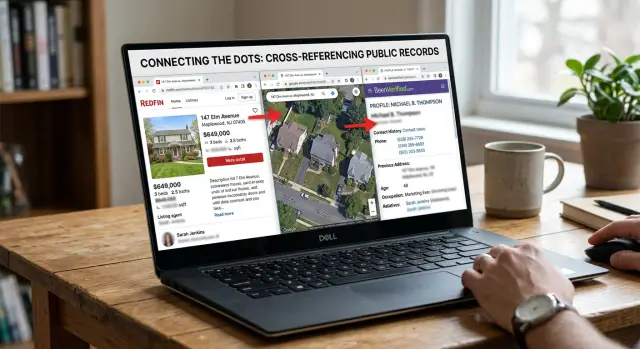
Why property photos create a real privacy risk
A single exterior photo can reveal far more than most people realize. To a scammer, it is not just a picture of a house. It is a collection of clues: the roof shape, driveway, porch, windows, fence, trees, and the way the home sits on the lot.
That can be enough to narrow down an address quickly, especially in newer subdivisions or on quiet streets where homes have distinct layouts. If the image also catches part of the road, a neighboring house, or a street sign, the search gets much easier.
This usually works through comparison. Scammers line up listing photos with map views, satellite images, and street imagery. The roofline, lot shape, corner position, backyard size, and street layout help confirm whether they found the right place. One front photo gives them a starting point. A map view fills in the rest.
Once they have the address, the privacy problem gets much worse. Broker pages, old sale listings, people-search sites, and data brokers often connect that address to real names. In many cases, they also show age ranges, relatives, phone numbers, and past addresses. Now the house photo is tied to a person, not just a property.
Small visual details often make the final match. A bright front door, a custom mailbox, a detached garage, a backyard pool, or a unique window shape can turn a likely guess into near certainty. Even a photo taken from an upstairs room can reveal enough of the block to confirm the location.
That is the real issue. The risk is not only that someone can see your kitchen or front yard. It is that public images, map views, and broker data can be stitched together into a profile that feels personal enough to use in a scam.
A photo may look harmless on its own. Paired with the rest of the web, it can identify a household with surprising accuracy.
What scammers match together
This kind of fraud is less about one photo and more about overlap. A single listing image might not say much. A full set of photos, map views, and public records can turn that same home into a strong identity match.
The front exterior is often the starting point. It shows the roofline, driveway shape, garage placement, front steps, and entry points. Even when the house number is hidden, the layout can still be enough to spot the same home in street imagery or older listings.
Backyard photos fill in the gaps. A pool, fence line, shed, deck, or view behind the house can narrow things down fast. If the front looks similar to nearby homes, the back often gives away which one it is.
Then comes map and street imagery. That adds another angle and helps confirm the lot shape, corner position, trees, neighboring homes, and where the house sits on the street. At that point, there is not much guesswork left.
After the house is pinned down, broker records can attach a name to it. Those records often show who owned the property, when it sold, and older addresses tied to that person. Old addresses matter because they often lead to even more records.
People-search sites make the last jump easy. Once an address and owner name are in place, those pages can connect the home to phone numbers, relatives, age ranges, email addresses, and previous cities. That bundle is enough to pass weak identity checks or build a convincing phishing message.
A scammer does not need perfect data. They just need enough pieces that all point to the same person.
Picture a house with a curved driveway, a blue backyard pool, and a small white shed. The listing photos show all three. Street view confirms the driveway, broker data gives the owner name, and a people-search page adds a mobile number and two relatives. The scam suddenly feels personal, even though it started with real estate photos.
That is why listing privacy problems often go beyond the listing itself. If your address also appears on people-search pages, removing that broker data cuts off one of the easiest ways to connect your home to your identity.
A simple example of how it happens
Imagine a home sale from a few years ago. The owner moves out, but the old listing stays online. The photos still show the front of the house, the side yard, and a backyard fence with a pattern you would notice right away.
A scammer finds that listing and starts comparing details. The house sits on a corner lot, which already makes it easier to pick out. The fence line, driveway, and angle of the backyard narrow it down even more.
Then they switch to map view. From above, the lot has the same odd shape as the one in the photos. The roof outline matches too, including a small extension over the garage. Now they are fairly sure they found the right property.
The next stop is usually a broker page or sale record. Some pages keep past transaction details online long after the move. If the page shows who bought the home, the scammer now has a name to go with the house.
That changes the scam from a random message into a believable one. Instead of sending a generic text, they can write something like: "Hi Jordan, we missed a delivery at your home on Maple Avenue. Please confirm the address so we can reroute it."
A phone call can sound even more convincing. The caller already knows the street, the home type, and sometimes the purchase date. If they mention one or two details that match the old listing photos, many people assume the call is real.
This is the part people often miss. One photo may not seem dangerous by itself. But a photo, a map view, and a broker record can work together like puzzle pieces.
How the matching usually works
The process is usually simple and repetitive. A scammer does not need special access. They just gather enough public details to feel sure they have the right person.
A common pattern looks like this:
- They start with old sale or rental photos. Listing sites often show the front of the house, the kitchen, the backyard, and sometimes the view from upstairs.
- They compare those photos with map, satellite, and street images. A red front door, a curved driveway, a corner lot, a pool shape, or a fence line can be enough to match the listing to one exact home.
- Once they have the address, they check broker pages and property history pages for names tied to it.
- Then they search people-search sites and data broker pages for phone numbers, past addresses, age ranges, and relatives.
- With all of that lined up, the call or text feels real because it includes details a stranger should not know.
The photos are rarely enough on their own. The risk grows when listing images overlap with broker records and people-search data.
Picture a simple case: a scammer sees a backyard photo with a pool and a tall white shed. They find the same shed on satellite view, pull the address, spot a full name on a property page, then grab a mobile number and two relatives from a data broker. The next text does not feel random anymore.
That is why data broker removal matters. If contact records disappear from those sites, the photo match becomes much less useful because one of the easiest steps in the chain is gone.
What makes a home easy to recognize
To understand how this works, look at the details that make one house different from every other house on the block. Most people think of the full exterior shot first. In practice, smaller details often give a home away faster.
A bright front door, custom gate, painted mailbox, or unusual porch light can work like a fingerprint. The same goes for backyard features that are easy to spot from above or from the street, such as a pool, large deck, solar panels, or a detached garage set slightly off to one side.
Wide shots are riskier than they look. They can catch house numbers on the curb, above the garage, or on the mailbox without anyone noticing. Even if the number is blurry, the photo may still show enough to narrow things down when someone compares it with public records or a map.
The area around the house matters too. A car in the driveway, a school sign at the end of the street, or the name of a nearby business can place the home in a very small area. Corner lots are especially easy to spot because the shape of the sidewalk, crosswalk, and nearby trees often matches map imagery almost exactly.
Landmarks make matching even easier. A church steeple in the distance, a mural, a playground, or a row of storefronts can turn a generic listing into an exact location.
A simple example says it all: one photo shows a blue door, solar panels, and half of a street sign. Another shows a fenced pool and a detached garage. That can be enough for someone to scan the neighborhood on a map, find the same layout, and confirm the address.
If a photo shows something unique, assume it can be matched. That is usually the safer bet.
Common mistakes that raise the risk
Most people do not post one big piece of personal data. They leave a trail of small clues that fit together.
A common mistake is assuming an old home listing will fade away after the sale. Sometimes the main page disappears, but copies stay on broker pages, syndication sites, cached search results, and image archives. One set of exterior photos can keep circulating long after you think the listing is gone.
Another easy miss happens after moving in. People post a family photo on the porch, a yard project, or a new couch by the front window. If the account is public, those posts can confirm that the person tied to a name now lives at the same house shown in old real estate photos.
Renovation posts create problems too. Many people are careful about interior shots but forget the outside details. A photo of a new fence, driveway, mailbox, corner lot, or view from the deck can be enough to match your social post to a listing photo or satellite image.
Broker pages are another blind spot. Some keep a page that shows a property address, past listing details, and sometimes an owner or resident name pulled from public records. If your name appears there, the jump from house to identity gets much shorter.
The pattern is usually boring, not clever. Old listing photos stay online. A public social post confirms the house. A broker or data site ties the address to your name. A cached copy fills in anything that was removed.
That is why partial cleanup often is not enough. If you remove one page but leave your name and address exposed on broker and data broker sites, the same match can happen again.
What to do if you find your home photos online
The first step is simple: find every copy you can. Do not stop at one listing site. The same photo set often lives on old sales pages, broker profiles, rental posts, map results, and people-search pages tied to your address.
Start with a plain search using a few versions of your address. Try the full address, street abbreviations, your old ZIP code format, and any unit number. Then check image results for the front of the house, the kitchen, or another room that is easy to recognize.
Keep one running list as you go. A basic note on your phone is enough if it includes the site name, a screenshot or page title, what photo or detail is shown, and whether there is a removal option. That list matters because copies move around. A brokerage page may still show photos even after a large listing site removes them.
Next, ask for old photos to come down wherever that option exists. Focus on pages that show the exterior, map pin, floor plan, or a room layout that matches your social posts. If the page is outdated, say that clearly and ask for removal of the photos, not just the address text.
Then check your own posts. A family photo in the kitchen may feel harmless until it matches the same backsplash, window shape, or staircase from an old listing. If a post makes the layout easy to confirm, hide it, crop it, or replace it with a tighter photo.
People-search sites are the other half of the problem. They connect your name, age, relatives, and address, which makes house photos much more useful to a scammer. Work through those profiles one by one and opt out wherever you can.
If your address appears on many of these sites, manual cleanup gets slow fast. Remove.dev handles removals across more than 500 data brokers and keeps watching for relistings, which helps when the same address shows up again later.
The goal is not perfection. It is to break the chain in as many places as you can.
Quick checks you can do today
Start with your own address. Put it in quotes in a search engine and scan the first few pages, not just the top result. Old sale pages, rental ads, cached broker pages, and random directory sites often stay online for years.
This takes about 15 minutes and gives you a clear picture of how easily someone could connect your home to your identity.
A short review is usually enough:
- Search your full street address in quotes, then try shorter versions without the apartment number or unit name.
- Open any old real estate listing you find and look for exterior photos, front doors, mailbox shots, unique windows, or driveway angles.
- Compare those images with map and street views of your block.
- Check whether the page shows your full name, or whether your name appears on another page tied to the same address.
- Look up that address on people-search sites and see whether they also show relatives, past addresses, age range, email, or phone numbers.
The risky part is the overlap. A single listing photo often is not enough on its own. But once a photo, a map view, and a people-search profile all point to the same house, the guess becomes much stronger.
A useful test is to pretend you are a stranger trying to verify that the person named on a broker or people-search page really lives at that address. If the answer becomes obvious in a few minutes, your information is too easy to match.
Next steps if you want less of your data online
Start with the pages that connect your full name to your property. Old people-search pages, broker records, public record pages, and stale home listings cause the most trouble because they give scammers a clean match.
After that, reduce the photos that make the home easy to recognize. The front of the house is the obvious one, but smaller details matter too. A bright door, custom mailbox, unique fence, backyard mural, corner lot view, or nearby business sign can be enough for someone to confirm they found the right place.
A simple order helps. Check people-search and data broker pages first. Then review current and old sale or rental listings, search image results and map views for your address, and ask for removal or photo reduction wherever the site allows it. Save screenshots before and after each request. The note-taking part is dull, but it saves time later.
Keep a short log with the site name, what information appeared, when you sent the request, and whether it came back. Some sites repost data after a few weeks because they pull from another source, so a basic record stops you from starting over each time.
If you do not want to handle the broker side by hand, Remove.dev is one option. It automatically finds and removes personal information from data brokers, keeps monitoring for relistings, and lets you track requests in one dashboard. That can make the cleanup process much less repetitive.
Repeat the check after any event that creates a new trail online. A move, refinance, home sale, rental listing, or major remodel can all lead to new records and new photos. Checking soon after those events usually takes far less time than cleaning up months of reposted data.
FAQ
Can someone really find my address from one house photo?
Yes. One clear exterior photo can be enough to narrow down a home, especially on a quiet street or in a newer subdivision. Roof shape, driveway, porch, fence, trees, and nearby houses can all be matched against map and street images.
What parts of a listing photo make a home easy to recognize?
Small details often do it faster than a full front shot. A bright door, custom mailbox, odd fence, detached garage, pool, solar panels, corner lot, or part of a street sign can make a match much easier.
Why are old real estate listings still a privacy problem after a move?
Because copies tend to stick around. Even if one listing disappears, the same photos may still show up on broker pages, syndication sites, cached results, or image search.
How do scammers connect a house photo to my identity?
They usually combine public pieces until they all point to the same place. A listing photo helps find the house, a broker or property page can add a name, and a people-search site can add phone numbers, relatives, and past addresses.
Are backyard and interior photos risky too?
Yes, they can be. Backyard photos often show pool shape, fence lines, sheds, decks, or views behind the home, which are easy to compare with satellite images. Interior photos can also confirm a social post if the same window, staircase, or layout appears in both places.
What should I remove first if I find my home online?
Start with pages that tie your full name to your address. After that, go after old listing photos, map results, and any public posts that make the house easy to confirm.
How can I check my exposure in a few minutes?
Search your full address in quotes, then try shorter versions of it. Check old sale or rental pages, image results, and people-search sites, and ask yourself how quickly a stranger could connect the house to your name.
Do people-search sites make this risk worse?
They often make the jump from house to person much easier. Once a scammer has an address, those pages can fill in names, age ranges, relatives, phone numbers, email addresses, and older locations.
Will deleting or hiding social posts help?
It helps, especially if the post shows the porch, yard, street, windows, or other details that match an old listing. Cropping tighter, hiding older posts, or making the account less public can break an easy match.
Can a service like Remove.dev save time with this cleanup?
If your address appears on many broker and people-search sites, it can save a lot of time. Remove.dev removes personal data from over 500 data brokers, monitors for relistings, and tracks requests in one dashboard, with most removals finished in 7 to 14 days.