How property tax records become people search profiles
How property tax records become people search profiles starts with public parcel files, then moves through matching, resale, and reposting by brokers.
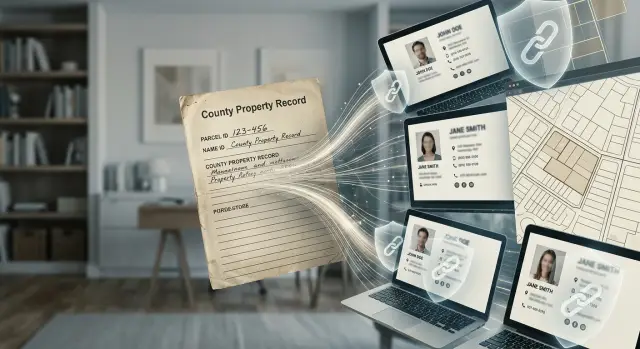
Why your home record shows up online
A home purchase feels private. Part of it becomes public almost immediately.
When a sale is recorded, the county usually creates or updates a parcel record tied to the property. That record often includes the owner name, street address, mailing address, sale date, and tax details. People search sites and other data brokers do not need much more than that to start building a profile.
County parcel data is easy to copy because it is organized, searchable, and often available in bulk. A broker can pull thousands of records at once, sort them by address or owner name, and load them into a database with very little cleanup. If the county makes downloads easy, the spread can happen fast.
Most people assume public records stay on a county website where few people will look. That is no longer how it works. Once a record is copied, it can be sold, shared, matched with other files, and reposted across many people search sites. One home purchase can turn into dozens of listings in search results.
That is why the problem feels larger than the original record. The county did not create a people search profile, but it supplied the raw material. Brokers take that material and combine it with other data, such as past addresses, phone numbers, relatives, and age ranges, until the result looks personal and oddly complete.
If your name appears next to your home address on sites you never used, this is usually why. The listing did not appear out of nowhere. It started with a public property record and spread as copies moved from one database to another.
What is in a property tax record
A property tax record looks plain at first. To a data broker, it is a bundle of identity clues.
The most obvious pieces are the owner name and street address. Many records also show a separate mailing address, which matters when the owner does not live at the property. That alone can connect a home, a second home, a rental, or a recent move.
A record usually includes the parcel number, sometimes called an APN. It may also show the sale date, sale price, assessed value, land value, building value, and the legal description used by the county. None of that sounds very personal, but together it helps confirm that one record is not being confused with another house on the same street.
Details brokers use
Transfer history is where things get stickier. County records often keep past sales, prior deed dates, and older owner names. If your name appeared on the property five years ago, that older entry can still help a broker connect you to the address today, even if you moved out.
Co-owner names matter too. A spouse, parent, sibling, or trust name can create extra matches. If a broker already has one person in its database, a shared property record can pull in the other names around it.
Then there are the small details that make matching easier. A middle initial, unit number, mailing ZIP code, lot size, year built, or exact purchase month can work like a checksum. One detail may be weak on its own. Four or five together are often enough for a people search site to decide the record belongs to you.
The broker does not need one perfect identifier. It just needs enough pieces pointing to the same person.
That is why parcel data privacy is hard to protect once a record spreads. Even when a people search site hides one field, the remaining pieces can still support the same match and keep a profile alive.
How the copying chain works
The basic pattern is simple: one public record gets copied, matched, and resold until it looks like a profile page about a person.
It usually starts at the county level. Many county offices put parcel records in searchable databases. Some also offer bulk downloads or sell large data files to vendors and other business users. A record posted for tax and ownership transparency can then move far beyond the county website.
Data companies get it in a few familiar ways. They scrape public search portals, buy bulk parcel files from counties or third-party vendors, or receive updates from aggregators that already collect county data. After that, they fold new records into their own databases and resell access.
This is where the chain gets messy. One company may pull the raw parcel file. Another buys that file, cleans it up, and adds mailing addresses. A third adds phone numbers, age ranges, relatives, or past addresses from other sources. By the time the record reaches a people search site, it no longer looks like a tax record. It looks like a neat personal profile.
The matching step is what makes the spread feel invasive. Software compares names, street addresses, mailing addresses, sale records, and other identity clues. If enough details line up, the system treats those records as belonging to the same person. The match is not always right, but once it is made, it can spread fast because brokers copy from one another too.
A common chain looks like this:
- The county posts parcel data.
- A data seller copies or buys it.
- Matching software connects it to other records.
- Broker sites publish a profile under your name.
After that, smaller sites often copy from larger ones. So one home purchase can turn into dozens of listings across people search sites. That is why removal usually takes more than one request. You are not dealing with a single page. You are dealing with a copying loop.
How brokers decide the record belongs to you
Most broker sites start with a rough guess. If a property tax record shows Jane Miller at 24 Oak Street, and another source shows a Jane Miller tied to the same address, the site may treat that as a match and build a profile around it.
That first pass is often loose. Exact name matches help, but many sites will still connect records when the street address lines up and the city, ZIP code, or county also fit. That is one reason common names end up in the wrong profile so often.
After that, brokers try to narrow the match with smaller details. A middle initial can separate one John R. Davis from another John A. Davis. An age range helps too, even if the site only knows someone is likely in their 40s or 50s. Relatives are another strong clue. If several records show the same last names appearing together over time, the broker may decide those people belong in the same household.
Co-owners make this messier. If a home is owned by spouses, or by a parent and adult child, one property record can pull both people into the same web of matches. Then each person can inherit extra records from the other. A search profile that started with one parcel record can end up showing two names, several phone numbers, and multiple past addresses.
Old mailing addresses also keep profiles alive. Many tax records list a mailing address that differs from the property address, such as a previous home, a rental, or a work address. Brokers save those older links and keep reusing them. Even after one listing is removed, the profile can return because another site still ties your name to that older address.
Picture a simple case. Sarah buys a house after getting married. The county file shows her new last name and home address, but the tax bill still points to her old apartment for a few months. A broker matches both addresses, adds her spouse from the deed, and then pulls in older phone and people search data. That is how one public record turns into a much larger profile.
This is why public records removal often has to cover related profiles too, not just the first page that shows your name.
How to check whether your record has spread
To see whether a tax record has spread, search the way a broker would. Start with your full name plus your city and state. Then try older versions too, such as a middle initial, a shortened first name, or a prior last name. These sites often keep stale records long after the county file changes.
Next, search the property itself. Use your full street address, then try small variations. Drop the unit number, use common abbreviations, and search the mailing address tied to the tax bill if it is different from the property address. Many broker pages start with an address match and only later attach a name.
A simple routine works well:
- Search your name with your city and state.
- Search your full street address, then a shorter version.
- Search any mailing address tied to the tax record.
- Search both with and without quotation marks.
When you find a profile, compare it with the county record line by line. Check the owner name spelling, street address, purchase year, assessed value range, parcel details, and any mailing address shown. Then look at the profile itself. If it also lists your age band, relatives, or past addresses, the record was probably copied, matched, and blended with other sources.
One matching detail can be a coincidence. Two or three usually are not.
Keep your evidence in one place from the start. Save a screenshot, the site name, the date, and the exact search that found the page. If the page has a profile ID, page title, or a note like "possible owner," save that too. A spreadsheet or simple notes file is enough.
For example, if you bought a home and had tax mail sent to your old apartment for a few months, a broker may show both addresses on one page. That is often enough to connect the parcel record to a broader profile, even if the county site itself shows only basic ownership data.
A simple example from one home purchase
Maria Chen buys a house and signs the closing papers under her full legal name, Maria L. Chen. Soon after, the deed and tax record are filed with the county. On the county property page, her name appears next to the home address and the mailing address she used for tax bills.
That page is public. It may look plain and harmless. For data brokers, though, it is a clean starting point: a real name tied to a real place.
One broker copies the record and runs a match against other databases. It checks whether a Maria L. Chen already appears in phone records, old address lists, or marketing files. If the address history lines up and one phone number has been seen near that address, the broker may decide it has the right person.
At that point, the profile starts to grow. The broker can attach a phone number, past addresses, and names of people who likely lived with Maria before, such as a parent, spouse, or sibling. The county page did not list all of that. The public record simply gave the broker enough to connect the dots.
Then other people search sites join in. Some buy a data feed. Others copy from another broker. One may add an older phone number from a past address. Another may attach a likely relative from household records. A third may add an email tied to an old signup list or a home value estimate tied to the parcel page.
After a few weeks, Maria may find several versions of the same profile online. One site shows the correct middle initial. Another drops it. A third gets part of the record wrong but still shows the same house and relatives. That is one reason removal takes time. You are usually dealing with copies, not one original listing.
If Maria tries to clean this up by hand, she has to track each listing and submit separate requests. That is the part most people underestimate.
Common mistakes that slow removal
The most common mistake is simple: people remove one profile, see it disappear, and stop. That feels finished, but it rarely is. One property tax record can spread to many people search sites, and those sites often copy from one another. If you clear one listing and ignore the rest, the same address and owner details can pop back up a few weeks later.
A small example makes this clear. Maria removes her profile from one site that showed her home address. Another broker still has the same parcel record under "Maria L. Santos," and a third has it under her married name. The first removal helps, but it does not stop the others from feeding fresh copies back into the system.
Another problem is inconsistency. If one request says "Mike Turner," another says "Michael A. Turner," and a third leaves out the middle initial, brokers may treat them as separate people. That can lead to partial removals, rejected requests, or a record that stays live under a slightly different profile.
It helps to pick one consistent identity set before you start. Use the same spelling, the same email address, and the same proof format each time. If a broker needs extra variants, add them clearly instead of changing your main details from one request to the next.
People also forget the older details that make matching easy. Past addresses matter. So do maiden names, common misspellings, nicknames, and co-owners listed on the deed or tax record. If your spouse, parent, or former partner appears beside you in county records, broker sites may build separate profiles from the same property and connect them later.
One last mistake is assuming the county record itself can always be hidden. In many places, property tax and parcel records are public by law. You usually cannot make the original record vanish just because it is online. What you can often remove is the broker copy, the searchable profile, and the repackaged page that makes the record easy for anyone to find.
That difference matters. If you focus on the broker layer, keep your identity details consistent, and include old names and addresses, removals go faster.
A quick checklist before and after removals
A lot of removals fail for a basic reason: the wrong profile gets flagged first. People search sites often mix similar names, old addresses, and partial records. Spending a few extra minutes upfront can save weeks of back-and-forth.
Before you send requests
Make one short master note with every version of your identity tied to the property. That usually means your full name, common shortened versions, maiden or former names, and every address format you can find. A site may list "123 Main St," "123 Main Street," or a unit number you forgot was public.
Before submitting anything, make sure the profile actually points to you. Confirm that it shows your property address, age range, relatives, or another detail that clearly fits. Write down each name and address variation shown on the listing, save the site name and exact profile title, and take a screenshot before the page changes.
If a record looks close but not exact, slow down. A bad request can leave your real profile untouched while a similar person's page disappears instead.
After the first round
Removal is rarely one-and-done. Larger broker sites get most of the attention, but smaller sites often copy data later or keep older snapshots live for weeks. That is why a second pass matters.
Recheck the same profiles after two to four weeks. Search your name with each address version, not just your current one. Look for copied profiles on smaller people search sites after the larger ones are gone. If a page comes back, submit a new request right away.
This part is repetitive, but it works. A removed profile can reappear under a slightly different street format or a middle initial that was missing before.
If you do not want to manage that cycle by hand, Remove.dev automates removals across more than 500 data brokers and keeps monitoring for relistings, which is often the hardest part to stay on top of.
What to do next
Once you understand the chain, start with the pages that expose the most.
A profile with your full name, home address, age, relatives, and phone number deserves attention before a thin listing that only shows a parcel match. Focus first on the pages that make it easy for someone to connect your home to the rest of your identity.
Before filing a stack of opt-out requests, contact your local tax assessor, recorder, or property appraiser office. Ask a direct question: which property fields are public in my area, and which ones can be limited, corrected, or kept off public search tools? The answer changes by county, and it helps to know what starts at the source and what was added later by broker sites.
A simple plan works best:
- Handle the broker profiles with the most personal detail first.
- Save screenshots, dates, and exact profile names before you submit removals.
- Ask your local office what is public, especially owner name, mailing address, sale date, and parcel history.
- Check again after a move, refinance, marriage, divorce, or title change.
That last step matters more than most people think. A record can disappear from one site and return after the next data refresh. If your mailing address changes, or a new deed gets recorded, matching systems often treat that as fresh material.
If you want less manual work, Remove.dev can handle the repeat process, track each request in real time, and keep watching for relisted pages after the first takedown. That is often easier than spending weekends chasing the same record across site after site.
FAQ
Why did my home address show up online after I bought a house?
Because the home sale usually creates a public county record with your name and address. Broker sites copy that record, match it with other data, and turn it into a profile page.
What parts of a property tax record help brokers identify me?
Owner name, property address, mailing address, sale date, parcel number, and past transfer history are often enough. When those details sit next to old addresses, relatives, or phone data, the match gets much stronger.
Can a people search site match me even if some details are missing?
Yes. Brokers do not need one perfect match. A few details that line up, like your name, address, mailing ZIP code, or a co-owner, can be enough for them to post a profile.
How can I check whether my property record has spread to broker sites?
Start with your full name plus city and state, then try old names, nicknames, and prior addresses. Search your full street address too, including short versions, and save screenshots of any profile that clearly points to you.
Why did my profile come back after I removed it once?
Usually because other broker sites still have the same record and keep feeding copies back into the system. A profile can also return after a new county update, a move, or a title change gives brokers fresh data to match.
Can I remove the original county property record?
Often, no. In many places the county record is public by law, so the better target is the broker copy that makes your information easy to search and reuse.
What mistakes make property record removals slower?
People often remove one profile and stop, or they submit requests with different name spellings each time. Old names, maiden names, past addresses, and co-owner names also get missed, which leaves easy ways for sites to rematch the record.
Should I search old names and addresses too?
Yes, because brokers love stale data. An older mailing address or former last name can keep a profile alive even after your current details are removed.
How long does this usually take?
If you do it yourself, timing varies by site and you may need several rounds. With Remove.dev, most removals are completed within 7 to 14 days, and the system keeps checking for relistings after that.
Is it better to handle this by hand or use a service like Remove.dev?
Manual opt-outs work, but they take time because you have to find each profile, send separate requests, and check later for reappearances. Remove.dev handles removals across more than 500 brokers, tracks requests in real time, and keeps watching for profiles that come back.