Registered agent services vs home address for privacy
Registered agent services vs home address can change how much of your personal info becomes public. See the privacy tradeoffs for solo owners.
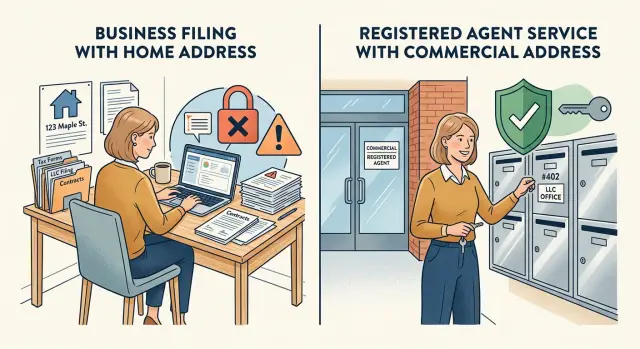
Why this choice matters when you work from home
If you run a business from your kitchen table or a spare bedroom, the address you put on a filing is not just paperwork. It can be your front door.
That is why the choice between a registered agent and a home address matters so much for solo business owners. The address used on formation papers, annual reports, and similar filings can end up in public business records that anyone can search.
Once it is public, it rarely stays in one place. Customers can find it. Marketing companies can copy it. Data brokers often pull business records into people-search sites and other databases. One filing can lead to years of junk mail, sales calls, and a much easier path to your home.
Mail is only part of the problem. Some notices are routine, but others are sensitive, like tax letters, lawsuit papers, or state reminders. Getting all of that at home can blur the line between work and private life, especially if you live with family, roommates, or children.
For most people, the risk is not a dramatic worst-case scenario. It is steady exposure. Your street address appears in search results, gets copied into more places, and becomes much harder to pull back later.
A registered agent can reduce some of that exposure because it gives the state a different address for official notices. That can keep your home address off some records and out of some mail streams. But it does not hide everything on its own. Many states still ask for a business mailing address, a principal office address, or owner details on other forms.
That is the real tradeoff. Using your home address is simple and cheap, but it can make your private life easier to find. A registered agent adds a layer between your business and your home, which matters when your office and your living room are the same place.
What becomes public when you file business documents
Many solo owners are surprised by how much of a public trail a business filing creates. In many states, formation papers and later updates can be searched online by anyone, not just government staff.
Exactly what appears depends on the state and the form, but public records often include your legal name, your business name, your principal office or mailing address, your registered agent name and address, and sometimes contact details such as an email address or phone number.
That means a stranger can often search your business name and pull up your filing in minutes. They do not need a special reason. A curious customer, a marketer, a scammer, or an old acquaintance can all see the same database.
This is where business filing privacy gets messy. The state database is usually only the first stop. Other sites copy public filings and turn them into business directories, people-search pages, lead lists, and background reports. Once that happens, the same address or name may show up in several places even if you only submitted one form.
For a solo owner, that spread matters more than it seems at first. One filing can connect your work life to your home life if the same address appears elsewhere online. It can also lead to more junk mail, more sales calls, and the occasional fake compliance notice that looks official enough to fool a tired business owner.
Another problem is how long these records can stay visible. Even if you update an address later, older filings, annual reports, or archived copies may still be easy to find. The original entry can also live on in third-party databases long after the state record changes.
So the question is not just whether to use a home address on one form. It is how much personal information you want to place into a system built to be public. Once that information spreads, cleanup is slower and more frustrating than prevention.
What happens when you use your home address
Using one address for everything feels easy at first. If you work from home, that is already where you get mail, sign for packages, and keep your records. It also saves money, which matters when you are doing every job yourself.
The privacy cost comes later. When you put your home address on formation papers, annual reports, or other filings, that address may become part of the public record. In many states, anyone can look it up with very little effort.
Once your address is public, it often spreads. State databases are copied by search sites, business directories, and data brokers. Someone who starts with your business name can end up with your street address, and sometimes your phone number or relatives, after only a few searches.
Usually the result is less dramatic than people fear, but more intrusive than they expect. You may start getting more junk mail at home, more cold calls from vendors, and more lookups that tie your business directly to your personal life. In some cases, salespeople or process servers may show up at your door.
That can feel especially invasive if you live with family, work unusual hours, or simply do not want clients and strangers to know where you live.
Changing the address later is possible, but it is rarely simple. You may need to file an update with the state, pay a fee, and then change the address in tax records, licenses, bank accounts, and vendor profiles. Even after you fix the main record, older versions may still appear in copied databases.
That is the part many people miss. Updating a filing does not pull your original address back from every site that already copied it.
If that happens, cleanup services can help reduce broker listings after the fact. But cleanup is still cleanup. It is usually easier to avoid placing your home address in public business records than to chase it down later.
For a solo owner, this comes down to convenience now versus less hassle later. A home address is cheap and easy on day one. It can also make your private life much easier to find.
What a registered agent does and does not do
A registered agent is the person or company that receives legal papers and state notices for your business. It is your business's official contact for lawsuits, annual report reminders, and other formal mail.
For someone working from home, the main privacy benefit is simple: the agent's address can appear on some public filing forms instead of your home address.
That said, a registered agent does not make you invisible.
In many states, you still have to list other addresses when you form an LLC or corporation. That may include your principal office, mailing address, or the address for a member or manager. Depending on the state, some of that information may still become public.
So a registered agent helps with one part of privacy, not all of it. If you expect it to hide your name, home, and contact details everywhere, you will probably be disappointed.
The clearest way to think about it is this: a registered agent can replace your home address in the registered agent field on some forms and can handle official state mail during business hours. It usually does not cover bank records, tax filings, business licenses, or every address field on every form. It also does not remove information that is already online in people-search sites or old databases.
The cost is usually manageable, but it is ongoing. Many services charge yearly, and some charge extra for mail forwarding, scanning, or compliance reminders.
There are limits on mail handling too. Most registered agents are set up for official documents, not your regular business mail, customer returns, or packages. If you send everything there, you may run into rejected deliveries or extra fees.
State rules matter more than people expect. Some states are flexible about where you can use the agent's address. Others still want a real business or mailing address elsewhere on the filing.
If your goal is better privacy, a registered agent can help, but only as one layer. You still need to check every address field before you file.
A simple example for a solo business owner
Picture Maya, a solo marketing consultant who works from a spare bedroom in her apartment. She forms an LLC so clients can pay her business instead of paying her as an individual. When she fills out the state forms, she has a choice that seems small at first: use her home address or pay for a registered agent.
If Maya uses her home address everywhere the form allows, that address can end up in public records. In many states, anyone who searches the company name can see where she lives. A client, a stranger, or a data broker can copy it in seconds. A few weeks later, her address may start showing up on people-search sites, marketing lists, and other databases that are hard to clean up by hand.
Now compare that with filing through a registered agent. Maya pays a yearly fee, and the registered agent address goes on the parts of the filing where the state allows it. Her home address is less exposed from the start, which usually means fewer copies spread across the web later. That does not make her invisible, and she may still need a business mailing address or other contact details depending on the state. But it closes one obvious privacy leak.
That is the basic tradeoff. Use your home address and spend less money now, but accept more privacy risk. Pay for a registered agent and lower that risk, but add another business expense.
If the agent costs $100 to $200 a year, some people will see that as irritating overhead when the business is new. Others will gladly pay it if it keeps an apartment or home off public records and lowers the chance that the address spreads to data brokers. For many people working from home, that is the real math: a modest yearly fee versus a lot less exposure.
How to decide step by step
Start with the form, not your preference. States ask for different addresses, and the first question is simple: which of these fields will become public?
That answer shapes the whole decision. If your state requires an address that will be searchable online, using your home can turn a private detail into a long-term filing problem.
- Read every address field before you file. Look for the business address, mailing address, principal office address, and registered agent address. Some states publish all of them. Others publish only some fields.
- Check whether you can separate addresses. In many cases, your mailing address can differ from the address used for legal service. That gives you more room to limit exposure.
- Decide your comfort level. Ask yourself a plain question: am I okay with clients, marketers, strangers, or data brokers finding this address later?
- Compare cost with hassle. A registered agent fee may feel annoying when you are starting out, but fixing privacy mistakes later often takes more time, more forms, and more stress.
- Make the choice before you submit anything. Corrections may be possible, but they are rarely fun, and copied data can spread far beyond the original filing.
A simple rule helps: if an address might become public, treat it as if it will stay public.
If you are still on the fence, think about daily life rather than the filing fee alone. A freelance designer in a small apartment may care much more about home privacy than someone who already rents office space. The right answer depends on your risk, your budget, and how much exposure you can live with.
Mistakes that still expose more than you expect
A lot of solo owners pay for a registered agent and then undo the privacy benefit on the next form. The agent may keep one address off the public filing, but it does not cover every place your business information appears.
That catches people off guard. They assume the LLC or the registered agent means their home address is hidden now. Often, it is not.
One common mistake is using the registered agent for state paperwork but putting a home address on everything else. A city license, seller permit, invoice template, email footer, or payment processor profile can still point straight back to where you live. Once one public record picks it up, that address can spread.
Another easy mistake is reusing your home address in account details you set up in a rush. You may file the LLC one day, buy a domain the next, and accept the fastest autofill option. Now the state filing looks private, but another record gives the address away.
The leaks are usually pretty ordinary: annual reports that ask for a mailing address, local licenses filed after the LLC is approved, invoices and receipts with a home address in the footer, or old records that still show a previous address after a move.
Older filings matter more than most people expect. If you moved last year and updated your current paperwork, earlier documents may still sit in public databases. Someone searching your name or company can still find the old address.
A simple example makes the problem clear. A freelance designer uses a registered agent for the LLC, but her county business license lists her apartment, her domain record uses the same address, and her invoice PDF includes it in the footer. She paid for privacy in one place and lost it in three others.
The other big mistake is assuming the LLC itself gives privacy. An LLC can separate business and personal liability. It does not automatically hide your address from public records. Privacy depends on every address field you fill out, not just the first one.
A quick check before you submit forms
A filing mistake can leave your home address in public records for years. Spending a few extra minutes on the address section now is usually much easier than trying to clean it up later.
Different forms use different labels, and that is where people slip. One line may ask for a mailing address, another for a principal office, and another for the registered agent. If you move too fast, it is easy to paste the same home address into all of them.
Before you submit, do a short review:
- Read each address field one by one. Do not assume two fields mean the same thing.
- Search your business name in your state's record system before and after filing so you can see what the public actually sees.
- Check whether your mailing address and principal address can be different in your state.
- Review your website, contact page, business profiles, invoices, and social accounts. A careful filing does not help much if your home address is posted somewhere else.
- Save copies of every form you filed and any confirmation pages.
One habit helps more than you might think: slow down at the address section and read the form like a stranger would. Ask yourself, "If this becomes public tomorrow, am I fine with that?" If the answer is no, stop and check again before sending anything.
It also helps to compare the form with what already exists online. Many solo owners get the filing right and then post the same personal details in a website footer, an invoice template, or a social profile.
Keep your records in one folder. Save filed forms, renewal notices, and screenshots of the public listing. If privacy becomes a problem later, you will know exactly what was submitted, when it went live, and what needs to change first.
What to do next if you want less of your information online
The filing choice is only one part of the problem. If you work from home, the better approach is to treat privacy as an ongoing cleanup job with a few clear steps.
Start with the setup that matches your comfort level. If you are not comfortable with your home address appearing in public records, use a registered agent where your state allows it and check every form before you file. One wrong field can undo the whole plan.
Then look beyond the filing itself. Your address may already be easy to find through old LLC records, domain registrations, marketing profiles, people-search sites, or broker databases that collect public records and repost them.
A practical next step is to search your business name, your full name, and your home address separately. Make a short list of where your address appears first. Fix the sources you control, such as business profiles and account settings, and note which entries are government records and which are copies on other sites.
That distinction matters because copied data spreads quickly. A county filing or state record can be picked up by several data brokers and then reposted again by other search sites. Even when one public record cannot be changed, the copies often can.
Keep watching after the business is formed
Privacy is not a one-time task. New listings can appear weeks or months later, especially if your information was sold before you changed your filing setup.
Set a reminder to check for your address every month or two. Focus first on people-search sites and data broker pages, since those are often the places strangers, marketers, and scammers use.
If that sounds tedious, it is. Manual removals take time, and some sites repost your data after it reenters circulation. If your address has already spread beyond the original filing, Remove.dev can help by finding and removing personal data from data broker sites and monitoring for re-listings afterward.
The main goal is simple: keep your home address out of new filings, then reduce the old copies already floating around online. Doing both usually works better than doing only one.
FAQ
Do I need a registered agent if I run my business from home?
Usually, yes if you care about home privacy. A registered agent gives the state a different address for legal papers and state notices, which can keep your home off some public records.
It is not a full privacy shield, though. Many states still ask for a mailing address or principal office address on other forms, so you still need to review every address field before you file.
Will a registered agent keep my home address off public records?
Not always, but it often helps. The agent's address can appear in the registered agent field, which reduces one obvious way your home address gets exposed.
That said, some states still publish other addresses tied to the business. If you use your home in those fields, it can still end up in public search results.
Is it safe to use my home address on LLC or business filings?
It is okay if you are comfortable with that address becoming easy to find. The tradeoff is convenience now versus more exposure later.
Once a home address lands in business records, it can spread to directories, lead lists, and people-search sites. Changing it later is possible, but cleanup is usually slower and more annoying than avoiding it in the first place.
What information usually becomes public when I file business documents?
Often the public record can show your legal name, business name, registered agent name and address, and sometimes a mailing or principal office address. In some states, phone numbers or email addresses may appear too.
The exact fields depend on the state and the form. Before you submit anything, check what your state actually publishes online.
Can I change my address later if I already used my home address?
Yes, but do not expect a clean reset. You can usually file an update with the state and change the address in tax records, licenses, bank accounts, and other business profiles.
The harder part is old copies. Earlier filings and third-party sites may keep showing the original address even after the main record changes.
Does forming an LLC hide my personal address?
No. An LLC can separate business liability from your personal liability, but it does not automatically hide your address.
Privacy depends on the forms you file and the addresses you put on them. If you enter your home address in a public field, the LLC structure alone will not fix that.
Can I use a registered agent address for all my business mail?
Usually no. Most registered agents are meant to receive legal papers and official state mail, not everyday business mail, returns, or packages.
Some services offer mail forwarding or scanning for extra fees, but you should check the rules first. Sending all regular mail there can lead to rejected deliveries or surprise charges.
What other places can still expose my home address?
Yes, and this is where people slip. A careful state filing does not help much if your home address still appears on a city license, domain record, invoice footer, payment profile, website contact page, or social account.
The simple fix is to audit every place your business info appears, not just the LLC form.
How much does a registered agent cost, and is it worth it?
Most services cost around $100 to $200 a year. For many solo owners, that is a reasonable price if it keeps a home or apartment off at least part of the public record.
If you already rent office space or do not mind public exposure, you may not see the value. If you work from a spare room and want more separation, the yearly fee often makes sense.
What should I do if my home address is already showing up online?
Start by searching your business name, full name, and home address to see where it appears. Update the sources you control first, then work on copies on people-search and broker sites.
If the data has spread widely, a removal service can save time. Remove.dev helps find and remove personal data from broker sites and keeps watching for re-listings after removal.