Restraining order data removal: keep your address off the web
Restraining order data removal starts with safe searches, limited proof, and attention to records that can post your address again.
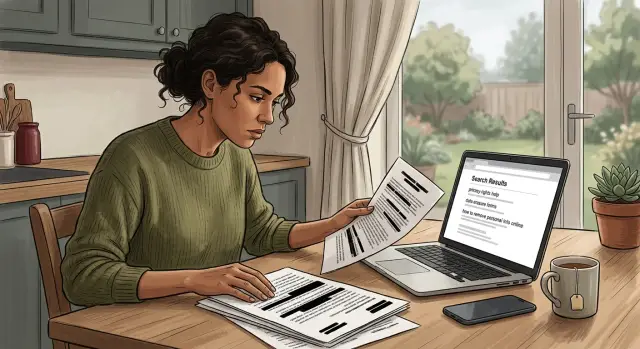
Why this is hard after a restraining order
A restraining order can help protect you offline, but it does not pull your address off the internet. Personal data often sits in many places at once, and one public record can spread far beyond the original source.
A single record can end up on dozens of people-search sites. One broker copies it, another copies that broker, and soon the same address shows up in search results, background check pages, and profile pages you never asked for. Even if you remove one listing, the same details may still be live somewhere else.
Court records, property files, and old account records are common starting points. A filing may show a mailing address. A deed or tax record may tie your name to a home. An old utility, shopping, or subscription account can leak an address into marketing databases that later feed broker profiles. None of that means you did anything wrong. It means ordinary admin records can become unsafe once they start getting copied.
Timing makes it worse. A page can disappear today and come back next month. Some sites refresh their data on a schedule. Others buy fresh records in bulk and rebuild profiles after a removal request. That is why address re-listing happens so often.
For people with a restraining order, this turns data removal into ongoing safety work. The goal is usually to reduce exposure fast, shrink the number of places your address appears, and keep watching for re-posts. Full erasure is rare, especially when a record is public by law.
Even partial progress matters. If your address used to appear on 40 sites and now it appears on 4, that is a real safety gain. Services such as Remove.dev focus on that practical work: find where your data appears, remove what can be removed, and keep checking for re-listings.
Start with a document-safe search
Before you send any removal request, find out where your address is showing up. Do that in a way that does not create more exposure.
Use a phone or computer you already trust and an account you already use. Avoid public Wi-Fi, shared devices, or sites that push you to create a new profile before you can search.
Treat this first pass like fact-finding. Search your full name in quotes when that works, your old address by itself, your phone number, common misspellings of your name, and combinations such as your name plus city or old address. Data broker pages are messy. One site may list a middle initial, another may drop a letter, and a third may tie your phone number to an address you no longer use.
When you find a result, a screenshot is often enough. It usually captures the page title, the site name, and the address or phone number linked to you. Add a short note with the site name, what was exposed, and the date you found it. That makes follow-up much easier if the listing comes back.
Be careful with pages that put a search box or "verification" form in front of the record. Do not upload court papers, ID cards, utility bills, or restraining order documents just to see what is there. Some of these pages are really lead forms that collect more personal data. A safer rule is to search with information the site likely already has and share nothing extra until you know a removal request is necessary.
This first pass does not need to be perfect. It needs to be safe, organized, and good enough to show where your address is still leaking.
What proof to share and what to hide
Send the least amount of proof that will get the listing removed. Before you attach anything, check what the site actually asks for. Some data brokers will act on a name, city, and profile URL alone. Others ask for address proof or an ID check. If a site does not clearly require a document, do not send one.
This matters even more when a restraining order is involved. A full court document can reveal case details, signatures, and other information that never needed to leave your hands.
If you do need to send proof, redact hard and keep only the part that matches the listing. In most cases you should cover:
- case numbers and filing numbers
- signatures, initials, and photos
- ID numbers
- dates of birth, account numbers, and barcodes
If a site wants proof of address, send only the part of the page that shows your name and the matching address line. On a bill or statement, black out everything else, including charges, account details, and any second address.
It also helps to build one redacted proof set and reuse it. A cropped address proof, a redacted ID if a site requires identity checks, and a short template note are usually enough. If a company asks for more than seems necessary, ask whether partial redaction is allowed. Many will accept it when the match is clear. If they refuse, stop and decide whether that listing is worth sending a fuller document.
Consistency matters. One unredacted upload can create a fresh risk later.
Records that can put your address back online
The hardest part is not the first takedown. It is the re-listing. An address often returns because one public or semi-public record gets copied, sold, scraped, and reposted by other sites weeks later.
If you want your address to stay off the web, look for the source records that keep feeding new listings. A people-search profile is rarely the whole problem.
The records that usually cause repeat exposure
Data brokers and people-search sites are the most obvious layer. They buy records in bulk, merge them, and republish them fast. If one broker gets a new county file or a fresh voter, utility, or change-of-address signal, your profile can reappear after a previous removal.
County property and tax records are another common source. If your name is tied to a home through an assessor, recorder, or tax database, that record can travel far beyond the county website. Mirror sites, marketing databases, and neighborhood pages often copy it.
Court records can spread even faster. A filing, docket entry, hearing calendar, or minute order may show an address directly or give enough detail for a site to match you to one. Even when a court later limits access, old docket snapshots and search indexes can linger.
Business records get missed all the time. If you formed an LLC, registered a sole proprietorship, or hold a professional license, your home address may sit in a secretary of state database or licensing record. Brokers scrape those too.
Then there is the messier layer: old directory pages, fundraiser posts, neighborhood notices, club rosters, and community listings. A single school page or charity event post can put your name, city, and street address in one searchable place.
A practical order helps. Check broker listings first, then county property and tax records, court calendars and docket copies, business registrations and licenses, and finally old community pages. If your address keeps returning, there is usually still one source record feeding the rest.
How to send removal requests step by step
Once you have a safe list of pages, work from the same address outward. If one street address appears on six sites, treat that as one problem with six copies. That makes it easier to see which pages may be feeding the others.
Start with the people-search pages that rank first when someone searches your name and city. Those are the results most people will see, and smaller sites often copy from them.
Use one process every time:
- Make a tracking sheet with the site name, page URL, address shown, request date, confirmation number, and next follow-up date.
- Send each request with the smallest proof set the site will accept. If the site will act on your name, state, and page URL, stop there.
- Save every confirmation right away. A screenshot of the form and any reply email can save time later.
- Set a reminder before you close the tab. Check again in 7-14 days, then follow up if the page is still live.
Keep each request short. Ask for removal of the exact listing, include the page URL, and say the posted address creates a personal safety issue. Long explanations rarely help, and extra detail creates a new trail.
Be strict about proof. Do not upload a full ID, a complete court filing, or anything that shows more than the site needs to verify you.
If your address appears on two large people-search pages, one phone directory, and one record mirror, send the two people-search requests first, then the other two the same day. If the mirror copied the address from one of the larger pages, it may disappear after the source record is removed. If not, your notes and confirmations are already in one place.
If you want less manual tracking, Remove.dev can keep requests and follow-ups in one dashboard and continue checking for re-listings.
When a record cannot be fully removed
Some records will stay public even when the risk is real. Court files, deed records, and other government entries may have rules that block full deletion. That does not mean you are out of options.
Start with a narrower ask. If the record cannot be removed, ask whether your street address can be suppressed, partly redacted, or hidden from public search. Sometimes the file stays on record, but the public-facing version can show less.
It helps to sort records into three buckets. Some remain public to anyone. Some are visible only in certain systems or to certain users. Others can still be edited, redacted, or hidden from search results. Keep notes on which type you are dealing with so you do not send the same request over and over to a source that cannot legally change the file.
Even when the original record stays public, copied versions often do not have the same protection. Data brokers, people-search sites, and small directory pages may have pulled your address from that source months ago. Those copies can often be removed, and that usually cuts most of the exposure.
This is where many people get stuck. They spend all their time on the original court or county page, when the larger problem is the spread. One public entry can feed dozens of profiles, and those profiles can keep putting the address back online.
Also watch for stale search results, cached pages, and screenshot copies. A page may be gone while the old version still shows in search for a while. In other cases, a forum post, social profile, or image upload keeps a screenshot of the address after the source page changes. Those need separate requests.
Treat each copy as its own problem. Remove the source if you can. If you cannot, remove every version that copied it and keep checking for re-listings.
A simple example
Say Nina moves into a new apartment after getting a restraining order. She wants her address off the web before the other person starts searching for her again. On a trusted device, she searches her name, city, phone number, and a few address variations. In one session, she finds three problems: a data broker profile with her current street, a court entry tied to the case, and a county parcel page linked to an older property record.
She handles the broker profile first because it can spread fast. A single broker listing often gets copied into people-search sites, marketing databases, and thin summary pages that show up in search results. She sends the removal request with only the proof the site requires, not a full stack of personal documents.
The court entry is different. In many places, the original record may stay public even when there is a real safety issue. Nina does not spend days chasing a full deletion that is unlikely to happen. Instead, she searches the case number and short case title to find copied summaries on other sites. Those copies are often removable even when the court page stays up.
The parcel page takes more patience. County property records are often public, and third-party property sites may copy them later. Nina checks what is actually shown - her full name, a mailing address, or both. If only the county page remains, she notes it and checks again later. If new property pages start showing the same details, she sends removal requests there before the record spreads.
That is what this work often looks like in real life. You may not erase every original record. The better move is to stop the fastest spreaders first, avoid oversharing proof, and keep watching the records most likely to put your address back online.
Mistakes that can make exposure worse
The biggest risk is rushing. A fast request can feel productive, but a sloppy one can put more private details in front of the very sites you want to clean up.
One common mistake is sending a full ID scan when a redacted page would do. If a broker needs proof, give the least amount of information that confirms the match. In many cases, that means covering the ID number, photo, signature, and any address the site does not need to see. A full scan can create a new copy of your data inside another company system.
Another mistake is searching under only one name. Old aliases, a maiden name, a shorter version of a first name, or a past apartment number can all lead back to the same address. Miss one of those paths and the same record may show up again a week later on another site.
A lot of people also skip the tracking log. After ten or twenty submissions, it becomes hard to remember what was sent, what was removed, and which site asked for more proof. Your log does not need to be fancy. The site name, the record you found, the date you sent the request, what proof you shared, and the follow-up date are enough.
The last mistake is stopping after the first round. An address may disappear from one broker, then come back through another source, a cached people-search page, or a public record index that updates later. Check again after a week or two, then again after a month. If the same record returns, note which name variation or old address it used. That pattern usually tells you where the exposure is coming from.
Quick checks and next steps
This is rarely a one-time fix. Addresses come back through old broker entries, fresh court filings, or a people-search site that copied data weeks ago.
A small routine works better than a one-time cleanup. Check once a month, keep your records tidy, and rerun your searches after any life change that could create a new public trail.
A short monthly routine
Search for your full name, old names, phone numbers, and address variations. Include small differences that people-search sites treat as separate records, like a middle initial, an old apartment number, or a shortened street name. Save screenshots with the date visible, note the exact site and the profile name used, and keep one redacted proof file ready for requests. Recheck any site that removed you before.
Keep all of this in one folder. If you ever need to resend a request, you will not lose time hunting for the same papers again. Your proof should show only what confirms identity or prior residence, not extra details that create a new exposure problem.
When to repeat checks sooner
Do another round sooner after a move, a legal name change, a marriage or divorce filing, a new court filing, or a utility account change that might show up in public databases later. Pay close attention to phone numbers. One number can connect your current address to older records in a few clicks.
If manual data broker removal feels like too much, that is understandable. Remove.dev can automate removals from data brokers, track requests in one place, and monitor more than 500 brokers for re-listings, which helps keep your address from quietly showing up again. The point is not perfection. It is to catch new exposure early, keep your proof ready, and make sure one leaked record does not rebuild your address across dozens of sites.