Identity trail from a screen name in fan forums and chats
Identity trail from a screen name often starts with a reused handle, a hometown mention, or old posts. See how brokers turn small clues into a full profile.
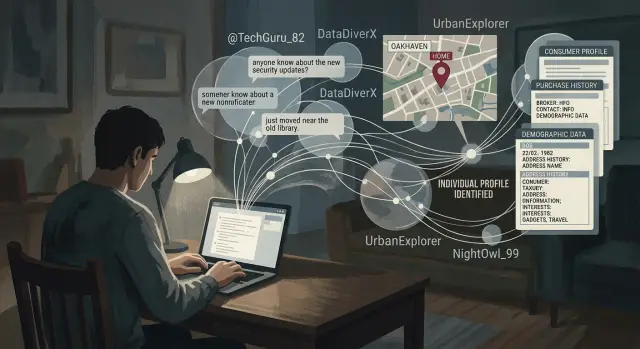
Why a screen name is not as anonymous as it looks
Fan spaces feel casual. That's why people often share more than they mean to. In a forum thread or creator chat, it feels normal to mention your city after a show, complain about your shift at work, or joke about being old enough to remember a certain release.
None of that feels personal in the moment. You're talking to people who get the reference, not filling out a form. That relaxed tone is exactly why privacy in fan forums is weaker than many people think.
A screen name looks anonymous because it isn't your legal name. But if you keep using the same handle, avatar, or short bio, it starts pointing back to one person. A post in one place says you live near Cleveland. An old profile on another site shows your birth month. A comment from years ago names a college, a local convention, or a sports team.
Each detail is tiny on its own. Together, they get specific fast. People also repeat habits without noticing. They use the same username across forums, game chats, and social apps. They keep the same profile photo for years. They reuse the same joke or sign-off line. Those patterns make matching much easier.
That's how an identity trail starts. Search results, quoted replies, archived forum pages, and public member lists can keep those crumbs alive for years. Even deleted posts can survive in screenshots or copied pages.
The details that give people away are usually ordinary: a hometown or neighborhood, a birthday clue, a school year, a repeated username, or an old bio that never got cleaned up.
Data brokers make this much worse. They collect names, addresses, phone numbers, relatives, age ranges, and past locations from many sources. Once they can match your handle to a likely person, the missing pieces stop being missing. A fan nickname can end up tied to a real address even if you never posted that address yourself.
The risk usually comes from accumulation, not one dramatic leak. A joke from 2018, a bio from 2020, and a comment from last week can all sit in public view, waiting for someone - or a broker database - to connect them.
The crumbs people leave without noticing
A screen name can feel separate from real life. In practice, small details pile up fast. Most identity trails don't start with one big mistake. They start with five or six tiny ones.
Bio lines are a common example. Someone writes "Ohio," "PNW," or "29, she/her" without thinking much about it. That may seem harmless, but it narrows the field right away, especially when the same account also talks about work hours, college years, or a recent move.
Posts about everyday life add even more shape. Mentioning a local comic shop, a weekend meetup, a county fair, or a train delay can point to one area better than people expect. A few months of casual posts can reveal where someone likely lives, where they go often, and what their routine looks like.
Reusing the same handle across different sites is another easy giveaway. If one name appears on a fan forum, a game account, a chat app, and a public social profile, those accounts start to connect. One site might reveal a first name. Another might mention a city. A third might show a photo. Once those details line up, the accounts stop looking separate.
Photos do a lot of this work on their own. A concert ticket on a desk, a street sign in the background, a school hoodie, or a badge from a local event can say more than the caption does. People crop for faces, but forget everything else in the frame.
Posting patterns matter too. If someone is active most nights between 8 p.m. and midnight, then goes quiet during a regular workday, that suggests a time zone and a daily schedule. Over time, those habits can match up with other accounts using the same name.
None of these details proves much alone. Together, they make a person easier to spot than most users think.
How brokers fill in the blanks
Data brokers rarely start with a full profile. They start with scraps. A reused username, an old forum bio, a cached profile page, and a few public posts can be enough to begin. If the same screen name shows up on a fan forum, a gaming site, and an old social account, that pattern already suggests they may be looking at one person.
Older accounts matter more than most people think. Even if you deleted a profile years ago, parts of it may still exist in search results, archive copies, quote replies, or reposted screenshots. A broker can compare those leftovers and spot the same nickname, avatar, writing style, or bio line. One old account may expose a first name. Another may mention a city. A third may show a birthday month.
The next step is matching those public clues with data that was never meant to sit together. That often includes leaked email addresses, phone numbers, shopping records, and marketing databases. If a forum account used a handle like "MikaWrites92" and a leaked email includes the same name pattern, the guess gets stronger. If both point to the same city or age range, the match gets tighter.
Location details do a lot of work here. A post about "our county fair," a local sports team, or "moving back to Tulsa" can narrow the search fast. Age clues help too. So do mentions of siblings, parents, or a spouse. Broker files often add the missing pieces: past addresses, aliases, likely relatives, and other people in the same household.
Once one profile fits well enough, nearby records start looking more believable. If a broker thinks a certain address belongs to you, other names at that address may be treated as family links. If a phone number appears next to that household, it may get attached to your profile too. That's how a screen name turns into something much more personal, and much easier to search, sell, or misuse.
A simple example of the trail
Take a fan account with the handle "StarMoth88." On its own, that looks harmless.
Now picture an old gaming profile using that same handle. It has been sitting online for years. Maybe it doesn't show a full name, but it uses the same avatar and ends posts with the same little phrase. That's often enough to make someone think, "This is probably the same person."
Then a forum comment adds a location clue. The account mentions moving back to Dayton last year after being away for school or work. That still doesn't sound like a full identity, but it narrows the search fast.
A public wishlist fills in more. The display name says "Mia," and a birthday gift post points to a birthday in October. Now the screen name is no longer just a screen name. It's a handle, a first name, a city, and a birth month.
That's where brokers do the rest. A broker listing for a Mia in Dayton can add a street address, age range, old addresses, and sometimes relatives. One listing may be messy. Two or three listings usually line up well enough to feel convincing.
The old gaming profile then comes back into the picture. Same avatar. Same writing style. Same niche interests. A stranger doesn't need perfect proof. They just need enough matches to feel confident that all these profiles belong to one person.
The trail might look like this:
- a fan account handle
- an old gaming profile with the same name
- a forum comment about moving back to Dayton
- a wishlist with a first name and birth month
- a broker record that adds a home address
None of those crumbs seems serious alone. Together, they turn a casual online persona into a real-world identity. That's why privacy breaks down so easily in fan forums and creator communities. The danger is usually not one big leak. It's a pile of small clues that fit together better than most people expect.
How to check your own trail
Start with the name you use most. Put your handle in quotes in a search engine and scan more than the first page. Save anything that looks tied to you, even if it seems harmless. A forum reply, an old profile, and a public playlist can connect much faster than people think.
Next, open each result and inspect the small details. Old bios, comment signatures, avatars, and profile photos often say more than the post itself. A city nickname, a graduation year, a team logo, or the same selfie used on two sites can narrow the search fast.
Write down every clue in one note. Look for details tied to place, school, work, family, habits, or dates. On their own, "lives near Austin," "class of 2018," and "night shift" sound vague. Put together, they can point to one real person.
A simple review helps:
- search your current handle, older handles, and common misspellings in quotes
- review public profiles on hobby sites, fan forums, creator pages, and social apps
- note repeated photos, phrases, posting hours, and location hints
- check whether the same username appears next to an email stub, payment tag, or wishlist
- edit or remove details that make separate profiles easy to connect
Reused usernames matter more than most people realize. If the same handle appears on a gaming forum, a merch site, and a creator chat, someone else can do the joining for you. Broker sites make that worse because they add age ranges, addresses, relatives, and past locations once they think they have a match.
When you find easy overlaps, change them. Swap out old avatars, trim bios, remove town names, and stop using one handle everywhere. If an account no longer matters, lock it down or delete it.
If your trail already reaches broker listings, manual cleanup can take a lot of time. Remove.dev is one option for handling that work. It removes personal data from more than 500 data brokers and keeps checking for relistings, which helps keep old matches from coming right back.
Why fan and creator spaces are easy to trace
Fan forums and creator communities feel private, even when they aren't. People relax, post fast, and talk the way they would in a group chat with friends. That's when small details slip out: a local concert, a late bus home, a joke about the weather in your town.
Those details don't look serious on their own. But this is exactly how an identity trail usually starts.
A fan space also creates patterns over time. If you join the same livestream every Thursday, mention grabbing dinner after your shift, and post meetup photos from the same area, you're giving away a routine. A routine can point to a rough location, then a smaller area, then a short list of real people.
The same thing happens with supporter pages, wishlists, and inside jokes. A first name on a payment profile, initials on a wishlist, or repeated jokes about a school or neighborhood spot can narrow things down fast. Meetup photos and event check-ins make it even easier when they place you in the same area more than once.
Inside jokes are a bigger tell than most people think. Saying "the cafe by south campus" or joking about a weird local bus route sounds vague to outsiders. It isn't vague when someone already has broker records with your age range, past addresses, and relatives.
Moderator rules can help with harassment, spam, and obvious doxxing. They can't stop brokers and scraping tools from copying public details while a post, comment, username, or profile field is visible. Even if a message is deleted later, the copied version may already be stored somewhere else.
That's why privacy in these spaces is harder than it looks. The community side makes people open up, and the public side makes those crumbs easy to collect.
Mistakes people make when trying to hide
Most people don't disappear online. They only blur one part of the picture.
That's the mistake. The trail often stays intact because the old clues still match each other, even after one account is changed or deleted.
A common move is deleting the newest profile and feeling done. Meanwhile, an old fan forum account from 2018 is still public, a creator server profile still shows the same nickname, and cached posts still carry the same writing style. One loose account can reconnect the rest.
Changing a username helps less than people think. If the avatar stays the same, or even just the same cropped selfie, people can still connect the old and new profiles in minutes. The same goes for a favorite phrase in the bio, a reused banner image, or a matching handle with one extra number.
Location crumbs cause trouble too. People remove their full city, then leave behind a suburb in the bio, a concert venue mentioned more than once, a commute detail like "two stops from downtown," or an old signature with a hometown sports club. A reply about local weather, traffic, or a school event can do the same thing.
Each detail seems harmless on its own. Together, they narrow the map fast.
Private groups create false confidence. A closed server, member-only forum, or paid community can still leak through screenshots, quoted replies, search indexing, or a member who copies posts elsewhere. Once that happens, the "private" context is gone, but your details stay attached.
Old replies are another blind spot. People clean the profile page but forget years of casual posts. A throwaway comment like "I had to leave early to catch the last train back to Oak Park" can matter more than the bio ever did.
The safer habit is boring, but it works: review old accounts, old posts, old images, and every place where the same avatar or local clue appears.
A quick check before you post again
Most identity trails don't come from one huge mistake. They come from a handful of details that seem harmless on their own. A town in one post, a college shirt in a photo, a comment about your shift at work, and an old username reused somewhere else can be enough.
Before you post, pause for 20 seconds and scan for anything that places you in the real world. That means more than your full name. A local cafe you visit every week, a school event, a sports ticket on your desk, or mail in the background can all narrow the search fast.
A quick self-check helps:
- read the post as if you don't know yourself
- zoom in on any image before uploading it
- check whether the handle matches a real-name account elsewhere
- ask whether the details would help someone search broker listings with better guesses
- think about what you posted last year, not just today
That last point matters a lot. One post saying "small city near Denver" is fuzzy. Another saying "night shift at St. Mary's" makes it much easier to place. Add a photo of a comic convention badge, and a broker profile can start to look like a confirmed match instead of a guess.
If you want one simple rule, don't stack clues. Keep your handle separate from real-name accounts. Trim location details. Crop photos hard. Skip live updates from places you visit often.
If your details are already showing up in broker databases, manual cleanup takes time. Services like Remove.dev exist for that exact problem and keep watching for relistings after removal. But the easier win is often this small habit: do a fast scan before you hit post.
What to do next if your details are already out there
If the trail is already visible, do the boring fixes first. They work better than panic.
Start with the oldest public profiles you still control, because those often hold the clearest clues: an old city in a bio, a school name, a photo taken outside your apartment, or a username you reused everywhere.
Clean up what people can connect in a few clicks. Update bios, remove town names and old job details, delete stale posts that mention places you go often, and change avatars if you've used the same face or image across multiple sites. A reused avatar can tie a fan forum account to a creator profile faster than most people expect.
A practical order is simple: review old forum, chat, and community profiles first; remove location hints, dates, and personal routines from bios and posts; swap reused avatars and retire old screen names if needed; then search for broker listings and submit opt-out requests where possible.
After that, look beyond the profiles themselves. Data brokers often fill in the rest by matching a name, age range, past city, relatives, and old contact details. Even if you clean up your posts, broker pages can keep the trail alive. That's why opt-outs matter. Remove as many listings as you can find, especially the ones that show your current address, phone number, or relatives.
Manual cleanup can turn into a long weekend, then another one a month later. If that's too much to manage, Remove.dev can handle removals across more than 500 data brokers and continue monitoring for relistings. That matters because deleted records often come back after a broker buys a fresh data set or republishes data from another source.
Don't treat cleanup as a one-time fix. Copies spread. Old pages get indexed again. New broker listings appear. A quick recheck every few months is usually enough to catch the obvious leaks before they build into a fuller profile. The goal is simple: make your screen name boring to trace.
FAQ
Can a screen name really lead back to me?
Yes. A handle by itself may look harmless, but it often gets tied to other clues like a city, school year, first name, avatar, or old bio. Once those details match across a few sites, it stops feeling anonymous.
What details give people away the fastest?
Location hints usually do the most damage. A hometown, suburb, local venue, work shift, school clue, or repeated event check-in can narrow the search fast. A reused avatar or the same username across sites makes that even easier.
Is it risky to use the same username everywhere?
It is a real problem. If one handle appears on a forum, game account, wishlist, and social profile, those accounts start to connect. One site may show your first name while another shows your city, and together that can point to one person.
Do deleted posts still matter?
Often, yes. Deleted posts can live on in search results, archive copies, screenshots, quote replies, or copied pages. That means an old comment from years ago can still help someone connect your current account to your real life.
Can photos in fan spaces expose my identity?
They can. People crop for faces but miss the street sign, ticket stub, school hoodie, mail on a desk, or event badge in the frame. Even a plain room photo can reveal more than the caption.
How do data brokers fill in the blanks?
Brokers usually start with scraps, not a full profile. A reused handle, an old profile, and a few public posts can be enough to guess who you are, then they add address history, phone numbers, relatives, and age ranges from their own records.
How can I check my own identity trail?
Search your current handle, older handles, and common misspellings in quotes. Open the results and look for repeated photos, bios, city hints, work details, school references, and posting habits that make separate accounts easy to join.
Should I delete old accounts or just clean them up?
Start by editing what is still public and easy to match. Remove town names, old job details, school clues, and repeated phrases from bios and posts, then swap reused avatars and retire old handles where you can. If an account no longer matters, locking it down or deleting it makes sense.
What should I change before I post again?
Pause before posting and read it like a stranger would. Check the image background, remove place names, avoid live updates from places you visit often, and ask whether this post adds one more clue to what is already public.
What can I do if broker sites already have my address or phone number?
If broker sites already list your data, cleanup can take a lot of time by hand. Remove.dev removes personal data from over 500 data brokers, most removals finish in 7 to 14 days, and it keeps monitoring for re-listings so the same records are less likely to pop back up. You can track requests in a dashboard, and plans start at $6.67 a month with a 30-day money-back guarantee.