Temporary email for data removal: where it helps and fails
Temporary email for data removal can help with signups, but many real opt-out requests need stable contact details for replies, proof, and follow-up.
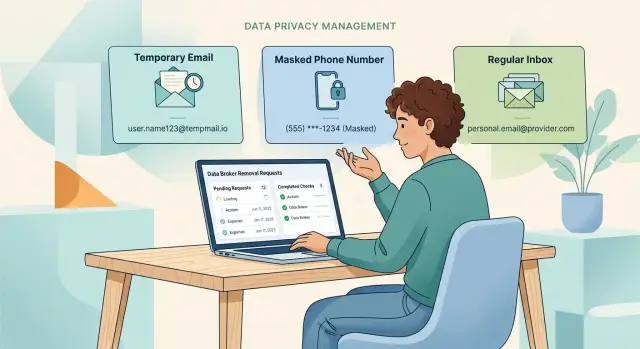
Why this gets messy fast
A data broker opt-out sounds simple on paper. You fill out a form, click a confirmation email, and move on. Real removals rarely work that way.
Many brokers reply days later. Some wait a week before asking for anything else. That delay is where temporary and masked contact details start to cause problems.
A temporary email for data removal might work for the first form, but the real confirmation can arrive later. If that inbox has expired, started deleting messages, or stopped forwarding, the request can die without much warning.
Phone numbers create the same issue. A prepaid number can feel like the safer choice when you do not want to use your everyday line. But some removals need a follow-up text or call after the first request. If that number no longer works, the case can stall halfway through.
Masked details can also slow down manual review. If the public record shows your full name and a long-used email, but the request comes from a brand-new alias that does not seem connected to you, a reviewer may pause the case and ask for more proof. That is not always unreasonable. Brokers are trying to avoid deleting the wrong record.
Small mismatches can snowball. You send a request with an alias, the broker replies to that same alias, then asks you to confirm details a few days later. If the inbox is gone by then, the request often resets or gets marked incomplete.
That is why manual removals take longer than most people expect. Sending the opt-out is usually the easy part. Staying reachable long enough to finish it is what takes time.
The safest approach is simple: use contact details you can keep active until the case closes, and ideally a bit longer. Privacy tools still help. They just need to last through the full back-and-forth.
What sites ask for in real removals
Most people expect a short form and a quick deletion. Real removals are usually more annoying than that.
The first extra step is often email confirmation. You submit the request, then a message lands in your inbox asking you to click a button or reply from the same address. If you used a temporary email for data removal and that mailbox is already gone, the request can fail before anyone reviews it.
Phone checks are common too. Some brokers send a one-time code by text. Others use an automated call. A prepaid phone can work, but only if you can still receive the code later. Delays happen, and some sites send a second code hours or days after the first attempt.
Many brokers also ask you to point to the exact record you want removed. That usually means pasting the profile URL, uploading a screenshot, or naming the listing exactly as it appears. A note that says "please remove my data" is often too vague. If there are several people with the same name in the same state, the site will want help finding the right one.
They may also ask you to repeat details from the listing so they can match you to it. That can include your full name, city, age range, old address, or a phone number tied to the profile. It feels backward, because you are giving more information to a site that already has too much. Still, many brokers use that matching step to decide whether the request is real.
A typical removal looks like this:
- Submit the request.
- Confirm it by email or phone.
- Send the listing URL or a screenshot.
- Answer one follow-up if the first match fails.
That last step catches people off guard. You think the request is done, then a second message asks for one more detail, a better screenshot, or a reply from the same email thread. If no one answers, the broker may close the case without removing anything.
That is why your contact details matter before you start. In many real opt-out cases, the removal itself is not hard. The slow part is the back-and-forth.
Where alias tools help
Alias tools still have a real use here. If a broker only wants your name, the listing URL, and an email for follow-up, there is no reason to hand over the inbox tied to your work, bank, and everyday life. A relay address or single-use alias gives them a way to reply without dumping more mail into the account you actually care about.
Aliases are also useful when you are testing how a broker handles requests. Some forms accept masked contact details without any trouble. Others reject them right away. Using an alias on a lower-risk request lets you see how that form behaves before you commit to a more permanent address.
They help with clutter too. Brokers often send confirmation emails, follow-ups, and extra marketing that has nothing to do with your request. If all of that lands in your main inbox, it gets harder to spot the one message that matters. A broker-specific alias keeps each thread separate, which makes later checks much easier.
You do not need a complicated system. One dedicated inbox for privacy requests is usually enough. If you want more control, keep a separate alias for brokers that send multiple replies, save the exact address used for each submission, and check that inbox for at least 7 to 14 days after you send the request.
For many people, an alias works better than a throwaway inbox because it is easier to monitor and less likely to disappear too soon. It still protects your main email, but it does not vanish in the middle of the process.
If you are handling removals yourself, that setup keeps things tidy. If you use a service that manages requests for you, the same rule still applies: organized contact details make follow-ups easier and reduce the chance of missing a real reply.
Where temporary and masked details fail
The problem is simple. Many removals do not end with one form.
A broker may send a code right away, then another email days later, then a final confirmation after the listing is gone. If you used a temporary email for data removal and that inbox expires after a few hours, the chain breaks before the job is done.
A lot of people assume any reachable address will work. Sometimes it does. But some brokers treat your email or phone number as part of the proof that you control the request, not just a place to send updates.
Verification is often where things break
Prepaid and VoIP numbers are a common weak spot. Some sites block them for one-time codes. Others accept the request at first and fail later at the verification step. You think the opt-out went through, but the code never arrives or the number gets rejected.
Relay emails can create a quieter problem. The first message may come through, while the follow-up lands in spam, gets filtered by the relay, or never threads correctly with your earlier reply. Then you miss a message like "please confirm this removal," and the request sits there until it expires.
Shared alias systems can make proof harder too. If a broker asks you to reply from the same address, send a screenshot, or confirm access to the account, an alias routed through another service can slow things down. Support staff usually want the simplest possible match.
That match matters more than people expect. If the record shows your full name, home address, and a long-used personal email, but your request comes from a fresh masked address and a prepaid number, the case is more likely to land in manual review. That does not mean it will fail. It usually means more waiting and more follow-up.
This is the point where masked details stop helping and start adding friction. They work best when a site only needs a reply address. They work poorly when the site wants continuity, working codes, and a clear sign that the person asking for removal actually controls the contact method.
How to choose contact details before you send anything
Most removal requests fail for a boring reason: the site cannot reach you again.
Before you submit anything, choose contact details you can still use a month or two later. A request may start with one email, then come back with a confirmation link, a follow-up question, or a second check after the first attempt expires.
Use an email inbox you plan to keep for several months. If you are thinking about a temporary email for data removal, use it only when the site clearly accepts alias or forwarding addresses and does not seem to need ongoing replies. If the broker asks for identity verification later, a throwaway inbox can turn a 10-minute task into a restart.
The same rule applies to phone numbers. Use a number that can receive texts later, not just today. Some brokers send one code when you opt out and another if your record shows up again. A prepaid or masked number can work, but only if you know it will stay active and accessible.
Consistency matters more than most people think. Write your name and address the same way every time. If you use "Apt 4B" in one request and "Unit 4B" in the next, some sites may treat that as a different record. Pick one simple version and stick to it across every form, email, and reply.
You also need a paper trail. Save screenshots of the form before and after submission, confirmation emails or texts, dates, ticket numbers, and the exact contact details you used. That makes follow-ups much easier when a broker claims it never got your request, or when you have to circle back weeks later.
Aliases still help in the right spots. They are useful when a site allows them and you want to track who contacts you after the opt-out. But if a broker is likely to ask for identity verification for removals, your safest move is usually a stable inbox and a phone number you control.
A simple example
Mia wants to remove her details from a people-search site. She does what many careful people do first: she avoids giving out her main contact information. For the opt-out form, she uses a temporary email address and an app-based phone number she does not plan to keep.
At first, it looks like the smart move. The form goes through, and she gets a confirmation page.
A week later, the broker replies. They want one more step before they finish the request. In this case, they ask her to enter a code sent to the email tied to the request. Some brokers ask for a phone code instead, but the problem is the same.
Mia never sees the message. The temporary inbox has already expired, and she is no longer checking the app number. After a few days, the broker closes the request as incomplete.
She tries again, but this time she uses a dedicated long-term inbox created only for privacy requests. She checks it every few days and keeps using the same address for follow-ups.
That small change fixes three problems at once. She receives the verification code, she has a record of the request and case number, and she avoids exposing her main inbox to random sites.
The second request takes a little longer, but it gets finished. The listing comes down because she can answer when the broker asks for proof, a code, or a confirmation click.
That is usually the better middle ground: one inbox for privacy requests, kept active for the long haul, and used for nothing else.
Mistakes that stall removals
Most delays are not dramatic. They come from small mismatches, missed replies, and contact details that stop working halfway through the process.
One common problem is inconsistency. If you send one request as "Jon A. Smith," another as "Jonathan Smith," and a third with a different version of an old address, the site may treat them as separate people. That can trigger extra checks or a rejection.
Another common mistake is replying from a different address than the one on the original request. Some brokers expect the same email thread all the way through. Break that chain and the case can reset.
Temporary email for data removal can help at the start, but only if you keep watching that inbox. Many brokers send a follow-up a day or two later. Miss it, and the request often expires. The same thing happens with masked phone numbers if you cannot receive the code when it arrives.
A few days of silence can be enough to stall a case. Many sites move quickly when they first review a request, then close it just as quickly when they do not hear back.
People also send ID too early. They are trying to look cooperative, but it often creates more risk than benefit. If the site has not asked for ID, do not volunteer it. Many removals go through with a matching email reply, a code, or a simple confirmation of past addresses.
The most common self-inflicted problems are easy to spot:
- reusing an alias you no longer check
- replying from a different email address
- sending extra documents the site never asked for
- assuming a closed case will stay closed forever
That last point matters. Data brokers often republish records after a few weeks or months. A finished case is sometimes finished only for now.
Quick checks before you hit send
A removal request can stall for small, boring reasons. Spend two minutes checking the details now, and you can save yourself a week of follow-up later.
First, make sure the inbox you plan to use will still be open next month. Some brokers reply fast. Others take days or weeks. If you are using a temporary email for data removal, ask yourself one plain question: will I still be able to read that mailbox when the reply finally arrives?
Do the same check with your phone number. If the site might send a code, the number needs to work on short notice. Prepaid or masked numbers can be fine for some forms, but they are a poor choice if missing one SMS can kill the whole request.
The details in your request should match the listing as closely as possible. Small mismatches cause more trouble than most people expect. If the broker shows your middle initial, an old city, or a misspelled last name, copy that version where needed so they can find the right record.
Before you submit, save proof that the listing exists and proof that you sent the request. A quick screenshot and a note with the date are usually enough.
A short pre-send check helps:
- Use an inbox you can still open later.
- Use a phone that can receive a code today, tomorrow, or two weeks from now.
- Match the public listing as closely as possible.
- Save the page, date, and any confirmation screen or message.
- Know where replies will land, including spam or SMS.
That last step gets overlooked all the time. Replies do not always come back the way you expect. Some land in spam. Some arrive from a different sender name. If you use aliases or masked contact details, keep a simple note of which one you used for each broker.
What to do next
Make a plan before you send your first request. A temporary email can help with low-risk forms, but it often breaks the process when a broker follows up days later and expects the same inbox or phone number.
A simple system works better than guessing. Sort brokers by how much verification they seem to require. Use stable contact details for the harder cases. Save masked or temporary details for lighter requests. Keep a small log with the broker name, the date sent, the contact method used, and whether the case closed.
This does not need a fancy spreadsheet. A short note on your phone is enough if you keep it updated.
Be conservative with harder cases. If a broker asks for a reply within 72 hours, a text code, or a match against existing records, masked contact details may slow you down more than they protect you. In those cases, consistency matters more than anonymity.
If one broker only sends a click-to-confirm email, an alias is usually fine. If another asks for a text code and then sends an update ten days later, use a real number you control and an inbox you check often.
If the follow-up work starts to pile up, handing it off can make sense. Remove.dev handles removals across more than 500 data brokers, keeps track of requests in one dashboard, and continues monitoring for re-listings after a record comes down. That is useful because the hard part is often not the first opt-out. It is the repeat work when your details show up again.
The practical next step is simple: pick your contact method broker by broker, send a small batch first, and track what actually gets finished.
FAQ
Is a temporary email good enough for a data broker opt-out?
Usually not. A temporary email may work for the first form, but many brokers send confirmation links or follow-up questions days later. If that inbox stops working, the request often expires or gets closed as incomplete.
When does an alias email make sense?
An alias is fine when the site mainly needs a reply address and a simple confirmation. It helps keep broker messages out of your main inbox, and it is easier to track each request if you use a separate alias or a dedicated privacy inbox.
Why do removals fail after I already submitted the form?
Most often, the form submission is only the start. Brokers may ask for a code, the exact profile URL, a better screenshot, or a reply from the same email thread. If you miss that step, the case can stall even though the first form went through.
Can I use a prepaid or app-based phone number?
Sometimes, but only if the number will still work later. Some brokers send codes hours or days after the request, and some reject certain prepaid or VoIP numbers at the verification step. If one missed text can stop the case, use a number you control long term.
Should I avoid using my main email address?
A dedicated inbox usually works better than your everyday one. You keep your main address away from brokers, but you still have a stable place for replies, case numbers, and confirmation emails. That is a better middle ground than a throwaway inbox.
What details should match the listing?
Match the public record as closely as you can. Use the same name format, address wording, and profile URL shown on the site so the broker can find the right listing. Small changes like switching between apartment labels or name versions can slow things down.
Do I need to send my ID to get a record removed?
No. Send ID only if the broker asks for it and there is no simpler option. Many removals go through with an email reply, a text code, or a confirmation of past address details, so there is no reason to share more than needed upfront.
How long should I keep my email and phone active after I opt out?
Keep them active for at least a few weeks, and a month or two is safer. Many removals finish in 7 to 14 days, but delays happen and some brokers come back with another check after the first request.
What should I save after I send a removal request?
Save the profile page, the date you sent the request, any confirmation screen, and the exact email or phone you used. That record makes follow-ups much easier if the broker says it cannot find your case or if the listing returns later.
When is it worth using a service instead of doing removals myself?
If you are handling a few brokers and can stay on top of replies, doing it yourself can work. If the back-and-forth starts piling up, a service can save time by tracking requests, handling follow-ups, and watching for re-listings. Remove.dev covers more than 500 brokers, tracks requests in one dashboard, and keeps monitoring after removals so records do not quietly come back.