Voter data brokers: how records reach people search sites
Voter data brokers turn public voter rolls and added demographic details into searchable profiles. Learn how it happens and what you can do.
Why this catches people off guard
Most people think voter registration is a narrow civic record. You sign up so you can vote, maybe choose a party for a primary, and move on. You do not expect that same record to help build a public profile that strangers can find with a name search.
That gap between expectation and reality is why this feels invasive. A voter file can include your name, home address, age or birth year, party affiliation, and whether you voted in certain elections. It does not show how you voted, but even without that, it can reveal more than many people ever meant to share outside election use.
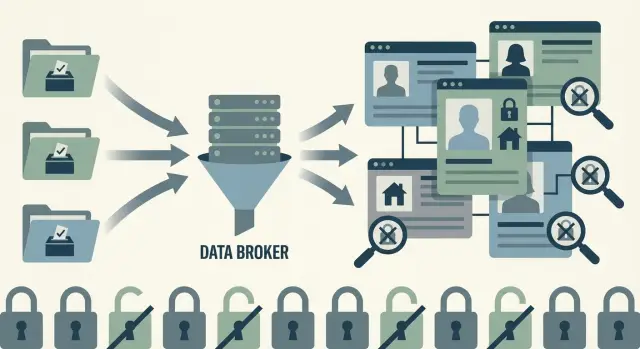
The surprise gets worse once a basic record stops being basic. A broker can match it with other sources and attach phone numbers, past addresses, likely relatives, property details, income ranges, or household data. Some of those fields are guesses, but they still make the profile feel personal.
This is how voter data brokers end up feeding people search listings. One public record gets copied, matched, repackaged, and sold again. After that, a people search page can show your name, age, address, and family connections even if the original voter record looked much simpler.
For most people, that feels wildly out of proportion. You registered to vote. You did not agree to have a detailed profile built around your home address and padded out with extra demographic tags.
There is also a visibility problem. A site rarely says, in plain language, "this page started with a voter file." Instead, it looks like a polished profile that somehow knows a lot about you. That distance hides the source, which is why many people discover the issue only after their data is already circulating.
Why this happens in some places and not others
Voter data does not work the same way everywhere. Access rules vary by state, province, or country, and those differences shape how easily brokers can get records and pass them into people search listings.
In some places, voter rolls are public records with broad access. A buyer may be able to get a full file in bulk, sometimes for a fee and sometimes with very little paperwork. In other places, access is narrower. Only a limited version may be available, or only certain groups such as candidates, political parties, journalists, or researchers can request it.
That difference matters. If a database can be downloaded in bulk, copied, and shared, outside companies have a much easier time reusing it, matching it with other files, and passing it around again. If the law blocks bulk access, removes fields, or limits who can receive the file, the spread is slower and usually less complete.
The rules on paper do not always settle the issue. A state may say voter data is only for election, civic, or research use while banning resale for general marketing. Once a file leaves the original source, though, policing every later use is hard. A copy can move from a campaign vendor to a data reseller and then into a profile that no longer looks like voter data at all.
Countries differ even more. Some keep electoral data under tighter privacy rules and do not allow easy commercial reuse. Others publish more of it or leave room for local agencies and private firms to collect overlapping records. That is why one person may never appear in a broker database because of voting activity, while someone in another place shows up with an address, age range, party registration, and added household data.
Time makes this messier. Laws change, election offices update policies, and court decisions open or close access. A record that was easy to get five years ago may be restricted now, yet older copies can still circulate. That is one reason people search listings often outlast the rule that first made the data easy to obtain.
What a voter record may include
A voter record can be more detailed than people expect. In many places, it starts with the basics: your full name, home address, age or birth year, voter ID number, and registration status. Some files also include party registration, which surprises people who assumed that detail stayed inside the election office.
What appears depends on local rules, but the pattern is familiar. A record may include your current address, age or birth year, party registration, precinct and district, county, registration date, and voting history. Older files may also keep past addresses in circulation.
One point often gets misunderstood. "Voting history" usually does not mean how you voted. It usually means whether you voted in a given election, such as a primary, midterm, or local race. Even that is useful to data sellers because it shows the person is active, real, and easier to match across records.
District and precinct fields may look boring, but they help confirm identity. If two people share the same name, those location details can separate one from the other. They also give brokers more ways to connect a voter file to other databases, especially when the address is already known.
Older exports can keep past addresses alive for years. If you moved recently, an older voter file may still point to your former home. Once that old address gets copied into another database, it can keep showing up in people search listings long after the original record is updated.
This is why voter data can produce profiles that feel oddly complete. Even when a voter record looks plain on its own, a few fields such as name, address, birth year, party registration, and turnout history can be enough to match a person with other public or commercial records.
That does not mean every voter file contains every field. But if you are trying to figure out why your details appear online, these are often the pieces that start the trail.
How appended demographics get added
A voter file often starts with basic record data. A broker then tries to fill in the blanks by matching that file with marketing lists, property records, household databases, and older broker data bought from other sellers.
Say a voter file shows "Jane Smith" at 42 Oak Street. A broker may compare that record with home sale records, change-of-address data, catalog mailing lists, consumer databases, and household graphs that connect people at the same address. If enough details line up, extra traits get attached to Jane or to everyone in that home.
Those add-ons often include an age band such as 35-44, an estimated income range, estimated home value, owner or renter status, likely relatives, education level, household size, or lifestyle tags.
Some of that comes from public records. Home value, for example, may come from property data. A lot of it is inferred. If a broker knows the address, the home price, the neighborhood, and the ages of other adults there, it may guess income range or family makeup. Those guesses can look precise even when they are not.
That is because matching is often probabilistic, not exact. A broker gives each possible match a confidence score. An exact name and address is a strong signal. A nickname, a middle initial, an old address, or a shared last name is weaker. Weak signals do not always stop the match.
A partial match can still end up on a profile if the system thinks it is close enough. If "Jennifer Smith" registered to vote at an address two years ago and "Jen Smith" now appears in a retail database tied to the same street and phone area, a broker may treat them as the same person. Then relatives, income range, or age band from one dataset can spill into the other.
Once that enriched record reaches people search listings, the result can look like one clean profile. It rarely is. More often, it is a stitched-together file built from public records, guesses, and near matches.
How a people search listing gets built
A people search listing is usually a stitched-together profile, not one clean record from one source. A site may pull a voter file, an old marketing database, a property record, and a few scraped public records, then merge them under one name.
That merge is often based on a simple match. If several records share a full name, an age range, and a city or ZIP code, the site may assume they belong to the same person. Sometimes that guess is right. Sometimes it pulls in details from two different people who only look similar on paper.
That is why one profile page can show a current address, two old addresses, a phone number from years ago, and a list of "possible relatives" all at once. Past addresses often come from older broker files or public records copied years earlier. "Possible relatives" are usually inferred from shared households, matching last names, or records showing people at the same address at different times.
Why old details linger
Search sites have a reason to keep old data around: people still search for it. An old address or former phone number may be wrong today, but it can still bring traffic from someone trying to reconnect, verify identity, or look up a neighbor. If outdated details still draw searches, many sites leave them up unless they are pushed to remove or refresh them.
The problem does not stop with one site. Data gets copied fast. One broker may buy or scrape a record set, another may copy that broker, and a people search site may copy both. After that, the same profile can spread to many places, each with slightly different details.
Voter data makes this even messier because the original record may be mixed with appended demographics and household data before it reaches the wider broker market. Once that combined file is out there, it can feed many people search listings, not just one.
That is why removing one page does not always solve the problem. If the same record set has already been copied across several brokers, the profile can reappear with the same old addresses and the same supposed relatives a few weeks later.
A simple example of how this spreads
Picture Maya. She registered to vote in 2019 while renting an apartment on Pine Street. Two years later, she moved to Denver, changed jobs, and started using her new address for deliveries, utilities, and store accounts.
A company that gets voter files may still have Maya tied to Pine Street. Another company has newer commercial data tied to her name, phone number, or email. When those records get matched, they can be merged into one profile even if the match is only partly right.
A people search site might end up showing Maya's full name and age range from public records, the old Pine Street address from her voter registration, the newer Denver address from account or shopping data, and a few "possible relatives" or associates based on shared addresses.
To a stranger, that page looks convincing. It has more than one address, a rough age, and names that seem connected. Most visitors will not stop to ask where each piece came from.
This is where the errors start to feel personal. Maya shared the Pine Street apartment with her cousin for a few months. Later, she lived with a roommate in Denver. A matching system may attach both people to her profile because they appeared at the same address at different times. Now the listing suggests family or close ties that were never real.
Small mistakes can make the page worse, not weaker. Another Maya with a similar age may get mixed in. An old phone number may now belong to someone else. A typo in one source can follow the record into several others.
That is why voter data brokers feed people search listings so easily. The voter record gives one solid-looking anchor. Added demographics and newer commercial data fill in the gaps. Even when some of it is wrong, the finished page still looks convincing enough to fool neighbors, employers, or anyone doing a quick search.
Once one site publishes that blend, other sites may copy it. Then one shaky match turns into several listings that all seem to confirm each other.
What to do step by step
Start with a plain search, not a form. Search your full name with your city, your age if it is listed online, and one or two past addresses. That mix often pulls up people search pages that simple name searches miss.
If you find a match, pause before sending any opt-out. Save screenshots of the profile, the page address, and the date you found it. A basic record helps if the page changes, comes back later, or if you need to show that the listing existed at all.
A simple order works best:
- Search your name with place details, age, and older addresses.
- Save screenshots and note the date for each result.
- Submit removal requests to people search sites one by one.
- Ask your local election office what parts of your voter record are public where you live.
- Check again after the first round, because reposts are common.
That third step is the slow part. Many people search listings pull from more than one source, so one opt-out rarely fixes everything. If your record appears on five sites, treat that as five separate jobs. Keep a small tracker with the site name, submission date, and result.
It also helps to ask your local election office a direct question: what voter record data is public in your state, county, or city? Rules vary a lot. In one place, the public file may show only the basics. In another, brokers may be able to match voter data with marketing data and build a much fuller profile.
A small example makes this clearer. Say a page shows your full name, current city, age range, and a street where you lived six years ago. Even if the people search site never says "voter file," that old address may have come from a voter record or from a broker that copied it and added more demographic data later.
After your first cleanup, check again in a week or two. Voter data brokers and people search listings often refresh their files on a delay. A profile that disappears today can come back after the next data update.
If you do not want to handle every request yourself, Remove.dev automates removals across more than 500 data brokers and keeps monitoring for re-listings. That fits this problem well, because copied records often return after the first opt-out.
Common mistakes that slow removal
Most delays come from small search mistakes, not from one stubborn site. With voter data brokers and people search listings, one wrong step can give a broker a fresh clue that the record still belongs to you.
A common mistake is using your main email address or current phone number in an opt-out form. That feels convenient, but it can create a new data point for matching. If a broker had not already connected that number or email to your profile, you may have just done it for them.
It is usually safer to give only what the site needs to locate the record and avoid sharing extra contact details unless the form clearly requires them.
Another problem is stopping after one profile disappears. Many sites keep duplicate entries for the same person under slightly different names, old cities, or old household records. You remove one page, search again a week later, and two more versions are still live.
The messy part is that duplicates often do not look like duplicates at first glance. One listing might use your middle initial, another your full middle name, and a third no middle name at all.
Past addresses trip people up too. If you search only your current city, you can miss pages tied to an apartment from six years ago or a county where you were registered before. Search with and without a middle initial, try older cities and past addresses, include common misspellings or shortened first names, and add your age range if a site shows it.
The last mistake is impatience. People often assume the issue is solved after one week because one listing vanished or an opt-out email arrived. That is rarely enough time.
Some removals take several days to process, and others need manual review. Remove.dev says most removals are completed within 7-14 days, which is a more realistic window than expecting everything to disappear almost at once.
Even after a successful removal, records can come back. A broker may refresh from a new source, or a people search site may rebuild a page from older data it still has on file.
A better approach is simple: remove, recheck, then recheck again. If you are doing it yourself, keep notes on every name variation, old address, and confirmation email. That small habit saves time because you are not starting from scratch each time a listing returns.
Quick checks and next steps
One round of opt-outs is rarely the end. With voter data brokers, records can move between sites quickly, and an old listing may stay live even after one source removes it.
Wait 7 to 14 days, then search again and compare what changed. Use the same search terms each time so you can spot real progress: your full name, your name plus city, your name plus an old address, and your name plus a phone number if one was exposed.
Look for patterns, not just one page. Compare new results with the screenshots or notes from your first search. Check whether a listing still shows an old home, age range, or supposed relatives. Open the highest-ranking sites first, because those are the ones other people will see.
Pay extra attention to connected profiles. A people search listing may tie your name to family members, former roommates, or addresses from years ago. Even if your own page is removed, those linked pages can pull the same details back into search.
Keep a short log as you go. You do not need a giant spreadsheet. A simple note with the site name, the date you sent the request, what was listed, and whether it came down is enough.
If manual opt-outs keep failing because the same data gets republished, ongoing monitoring usually makes more sense than starting over every month. That is the part services like Remove.dev are built for: repeated removals, tracking requests, and watching for old records that come back.
The practical next step is simple. Re-check after two weeks, update your log, and see whether the same details still appear on linked profiles. If they do, you are dealing with a re-listing problem, not a one-time listing.
FAQ
Why is my voter registration showing up on people search sites?
Usually because a voter file gave a broker a solid starting point. Once your name and address are in one dataset, other sellers can match that record with property files, older broker data, phone records, or household data and turn it into a public profile.
What details from a voter record can end up online?
It often starts with your name, home address, age or birth year, registration status, precinct or district, and sometimes party registration. Some files also show whether you voted in certain elections, which is turnout history, not your choices on the ballot.
Can people see how I voted?
No. Voter records usually show whether you voted in an election, not how you voted. That still gives brokers enough to confirm you are a real person and match you with other records.
Why do some people show up from voter data and others do not?
The rules are different depending on where you live. In some places voter rolls are easier to get in bulk, while other places limit access, remove fields, or restrict who can receive the data. Older copies can also keep circulating even after the rules get tighter.
How do brokers add relatives, income, or household info to a voter record?
Brokers match the voter record with other datasets tied to the same name or address. From there they may attach estimated income, home value, owner or renter status, likely relatives, or household size. Some of those details come from public records, but many are guesses based on patterns.
Why do old addresses stay online for years?
Because old data still gets copied and reused. A site may keep an older broker file, and another site may copy that version later, so an outdated address can keep showing up long after you moved or updated your registration.
How can I tell if a people search page may be using my voter data?
Look for clues like an old address, your age range, party registration, or turnout history that lines up with where you were registered. Then ask your local election office what voter data is public in your area. That will not prove the source on its own, but it helps narrow it down.
What is the safest way to submit an opt-out?
Use only the details needed to find the profile and avoid giving extra contact info unless the form clearly requires it. Sending your main email address or current phone number can give the broker a fresh data point to connect to your record.
How long does a removal usually take?
A realistic window is about 7 to 14 days for many removals, though some pages take longer. One page disappearing does not mean the whole problem is fixed, since copies on other sites may still be live.
What should I do if my profile comes back after removal?
Search again after a week or two using your name, city, age, and old addresses. If the same details keep returning, you are dealing with re-listings, not a one-time page. In that case, a service like Remove.dev can save time by removing data across more than 500 brokers and monitoring for new postings.