Why data removals take longer: API, forms, and law
Why data removals take longer often depends on the route a broker uses - API, web form, or privacy law - and the delays built into each step.
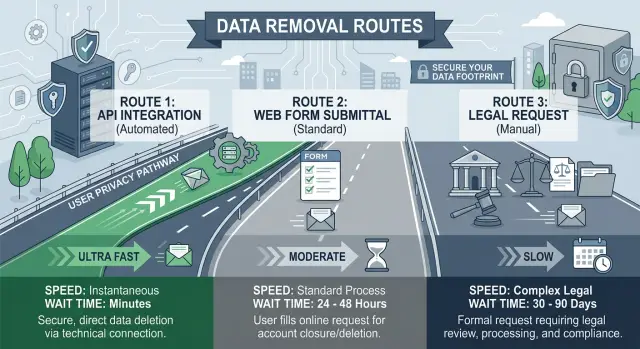
Why one removal finishes in days and another drags on
If you've ever filed two opt-out requests and watched one finish in 48 hours while the other sits for weeks, the difference usually has little to do with you. Most of the delay comes from the broker's own process.
Two sites can hold the same name, address, and phone number and still handle the same request in completely different ways. One removes the record in a day or two. Another leaves it pending, asks for extra proof, or sends it to a staff queue. A third treats it as a formal privacy case and checks it against legal rules before doing anything.
Maria Torres might appear on three people-search sites. One site removes her listing almost right away. Another waits for a staff review. A third acts only after a formal privacy request is logged and verified. Same person, same goal, different timeline.
Most removals follow one of three routes: API-based, form-based, or law-based. The route sets the pace. API requests often move fastest because the data goes straight into the broker's system. Web forms slow down when the site needs email confirmation or manual review. Legal requests can take longer because the broker may verify identity, check location, and work within a formal response window.
That is why personal effort does not always change the timeline much. You can submit the same details correctly to two brokers and still get very different results. Once you know which route your request is using, the wait feels less random.
API, form, and law in plain words
The end goal is the same in every case: get the record removed. What changes is the path the request takes.
An API-based removal is a direct system-to-system request. If the broker has built that connection, the details arrive in a standard format and the request can move quickly with less manual work.
A form-based opt-out is what most people picture first. You open a page on the broker's site, fill in your details, and submit it. After that, the request may sit in an inbox or review queue until someone checks it.
A law-based privacy request uses rights under laws such as CCPA or GDPR. This route is more formal. The broker often asks for proof of identity or location before it removes anything.
In simple terms:
- API-based means system to system.
- Form-based means website submission first, then review.
- Law-based means a formal privacy request with stricter checks.
Real life is messier than those labels make it sound. Some brokers use more than one route at once. A web form may feed into an internal system. An API request may still trigger manual review. A public form can also be the entry point for a legal request. From your side, two removals may look almost identical. Behind the scenes, they can be moving through very different workflows.
Why API-based requests move faster
API-based removals are usually the quickest because the request goes straight from one system to another. No one has to open an email, copy details by hand, or sort through a messy form first. That removes several slow steps.
A direct handoff also reduces small human errors. If the broker expects fields like full name, phone number, city, email, and profile URL in a set format, the request can land exactly where it needs to go. When those fields match the broker's record cleanly, approval tends to move faster because the system can identify the right person with less doubt.
Think of it like scanning a barcode instead of typing a product name into a search box. One is direct. The other leaves more room for mistakes, duplicates, and manual checking.
Fast does not mean instant, though. Even with an API, the broker may still queue requests, run fraud checks, or wait for a second internal process to remove the record from the public site. Some brokers update once a day. Others take a few business days before the change appears.
Bad data slows down an API request just as easily as any other method. If the name is misspelled, the address is old, or the profile link points to the wrong record, the broker may reject the request or send it for review. Missing fields cause the same problem. The pipe is fast, but it still needs accurate information.
A simple example makes the point. If a broker gets an API request with the exact name, current city, and the correct record URL, the removal may finish in a few days. If the same request says only "Chris Lee" with no other details, it can stall because the broker has no reliable way to tell which record should be removed.
So API-based removals move faster for a simple reason: less manual work and easier matching. When the data is clean, the process feels smooth. When the data is weak, even a fast system can only do so much.
Why form-based opt-outs get stuck
Form-based opt-outs look simple. Open a page, fill in the boxes, press submit. In practice, they are one of the main reasons removals take longer than people expect.
The first delay is often the confirmation step. Many brokers send a follow-up email and do nothing until you click it. If that message lands in spam, goes to an old inbox, or gets buried for two days, the clock has not really started yet. Some forms also use CAPTCHA checks, and those can fail, expire, or block repeat attempts.
Small mistakes create a lot of delay. A broker may ask for your full name, city, age range, and the exact record URL. If one field is blank, a date is in the wrong format, or the address does not match the listing, the request may sit until someone reviews it.
The same blockers show up again and again: typos in names or street numbers, missing fields that looked optional, copied links that are cut off, and format mismatches such as the wrong date style. None of those problems seem dramatic on their own. Together, they add days.
Even when the form goes through, many requests do not get processed right away. They land in a human review queue. That means an employee has to compare the request with the listing, check identity details, and decide whether the request is complete enough to act on. If that team works in batches, your request can sit for days before anyone opens it.
The hardest part is the silence. Form-based removals rarely show live status. You may get no confirmation page, no follow-up email, and no notice that the request is waiting for review. A one-week wait feels much longer when you cannot tell the difference between "received," "stuck," and "ignored."
Picture a typical delay. You submit the form on Monday. The confirmation email arrives on Tuesday, but you miss it. You find it on Wednesday night and click it. On Thursday, the broker spots a typo in the address and sends the request to manual review. By Friday, it feels like the site is ignoring you, when really the delay came from a chain of small pauses.
Why law-based requests often take longer
Law-based privacy requests sound stronger on paper, but they often move slower in practice. The biggest reason is identity review.
Before a broker deletes or discloses anything, it usually wants to make sure the request really came from you. That is not pointless red tape. It helps stop someone else from posing as you, getting access to your file, or deleting the wrong person's record.
Because of that, the broker may ask for more proof before it starts. Common requests include a reply from the email tied to the listing, your full name and current address, a screenshot of the record, or a masked ID. If that proof is blurry, incomplete, or does not match the listing closely enough, the case can pause.
Some brokers do not start the clock until they accept your verification. Others open the case first and then place it on hold while they wait for more documents. Either way, the back-and-forth adds time.
Legal requests also tend to run on formal timelines. Instead of acting right away, a broker may use the response window allowed under its internal process or the law it follows. So even a valid request can take weeks.
The slow part is usually the exchange itself. You send the request. The broker asks for proof. You reply two days later. The broker reviews it and asks for one more item because the address format does not match what it has on file. Then the case goes back into the queue.
A small mismatch can be enough. If the broker has "Jane Miller, 14 Oak St" and your request says "Jane A. Miller, 14 Oak Street, Apt 2," a human reviewer may stop and ask for clarification. That extra email thread can turn a one-week removal into a three-week one.
So when a legal request drags on, it often is not a refusal. It is usually a formal process, a verification gap, or both.
One person, three brokers
A simple example makes the timing difference easier to see.
Picture one person, Nina. She finds her home address listed on three broker sites and wants all three records removed.
The first broker accepts API-based requests. Nina submits her details, the system matches the record, and the request goes straight into the broker's removal queue. No inbox check, no extra paperwork. Her listing disappears in about two days.
The second broker uses a public opt-out form. Nina fills it out in a few minutes, but the broker sends a confirmation email before doing anything. She does not spot that email until the next morning because it lands in a crowded inbox. She clicks the link on day two, and only then does the real countdown start. That removal finishes around day eight.
The third broker does not offer a standard opt-out path for this case, so the request goes through a formal privacy route. The broker asks Nina to prove she is the person in the record before acting. She uploads a masked document on day three. The broker reviews it by hand, asks one follow-up question, and finishes the removal on day nineteen.
The spread looks like this:
- API-based request: about 2 days
- Form-based opt-out: about 8 days
- Law-based privacy request: about 19 days
That difference does not mean anyone failed. It usually comes down to process. One route is mostly automatic, one waits on confirmation and staff review, and one needs identity checks and formal handling.
How to tell what stage your request is in
The easiest way to stop guessing is to keep a small log. If you do not record the broker name, the submission date, and what happened next, every delay starts to feel mysterious.
Start with three basics for each broker: when you sent the request, how you sent it, and what proof you have that it was received. If you used a direct app connection, the route is probably API-based. If you filled out a page on the broker's site, it is form-based. If you cited CCPA, GDPR, or another privacy right, it is probably law-based.
Then look for receipt. Search your inbox for a confirmation message, case number, auto-reply, or any screenshot you saved after submission. If you have no proof at all, treat the request as "sent" rather than "in progress."
Next, check whether the broker asked for more. A lot of requests that look stuck are actually waiting on identity proof, an address match, or a reply from the same email address used in the request. Check spam too. Missing one message can add two more weeks for no good reason.
After that, compare the wait with the route. API requests often move in a few days. Form-based removals usually take longer because they may sit in a manual queue. Law-based requests often take the longest because the broker may review identity before acting and may work within a longer response window.
A simple status label helps keep things clear: sent, confirmed, waiting on proof, under review, removed, or follow-up due. Those plain labels make it much easier to tell the difference between a request that is truly stalled and one that is still moving at a normal pace.
Mistakes that add more waiting
A lot of delay comes from ordinary mix-ups, not stubborn brokers. If a request looks inconsistent, duplicated, or incomplete, it often gets pushed into manual review. That can turn a two-day job into a two-week one.
One common mistake is using the wrong route. If a broker has a standard opt-out form and you send a formal legal demand instead, the case may get routed to compliance staff instead of the faster removal path. Stronger language does not always mean faster action.
Another problem is changing email addresses halfway through. If you start with one address and confirm with another, the broker may not match the records automatically. Then someone has to check it by hand.
People also slow themselves down by resubmitting too soon. After a few quiet days, it is tempting to send the same request again and again. That often creates duplicate tickets, mixed notes, and more confusion inside the broker's system.
Missing the confirmation email is another classic delay. Many brokers send a link or code that expires quickly. If you miss that step, the request may never move forward even though it looked finished on your screen.
Then there is the mistake people make after a removal succeeds: assuming it is permanent. Some records come back after a later data refresh or a new sale of personal data. If nobody checks again, you may not notice until the listing is public all over again.
The best way to avoid extra waiting is dull but effective: use the route the broker expects, keep your contact details consistent, send one clean request at a time, and check again later to make sure the record stayed down.
Before you follow up
A lot of follow-up emails go out too early. Before sending another message, check whether the broker is actually late or whether the request is still within a normal window.
Start with the listing itself. If the page is still live on the broker's site, the removal likely has not finished. If the source page is gone but the name still appears in search results, that may only be a cached result. Search engines often take extra time to refresh after the original page has already been removed.
Then check whether you finished every step the broker asked for. Many form-based requests pause because the person never clicked the email confirmation link or never completed an identity check. Law-based requests can stall for the same reason if the broker asked for proof and got no reply.
It also helps to scan your inbox and spam folder for a quiet rejection. Some brokers send short emails that look like auto-replies, but they actually say the request was incomplete or the record could not be matched. If you miss that message, nothing else happens.
Timing matters too. An API request that has shown no movement for two weeks may need attention. A law-based request may still be within a normal window at that point. The route tells you when a delay is unusual.
If you do need to resubmit, keep it tidy. Use the exact details shown on the listing, include the correct record URL, and avoid sending extra personal data the broker did not ask for. Cleaner requests usually move faster.
What to do next
The practical takeaway is simple: stop treating every broker the same. Sort each request by route first. Is it API-based, form-based, or law-based? That one step sets better expectations right away.
API requests often move fast, so check for confirmation and then give them a few days. Form-based requests need closer attention because they often fail on small details like a missed confirmation email or a bad record link. Law-based requests usually need more patience because the broker may review identity, location, and the legal basis before acting.
A plain note log helps more than people think. Keep the date you sent the request, the route, any proof you uploaded, the reply you got back, and the date you plan to check again. That alone cuts down on duplicate requests and early follow-ups.
If you are handling a large cleanup, tools built for this work can help because the real challenge is not just one request. It is keeping track of dozens of brokers that all behave differently. Remove.dev uses the same three paths described here - direct integrations where available, browser automation for site forms, and formal privacy requests when needed - and keeps monitoring for records that get relisted later.
That last part matters. A removal is often not a one-time fix. The real job is getting the record down, checking whether it comes back, and sending the next request without starting from scratch.
FAQ
Why did one broker remove my info in days while another took weeks?
Usually, the broker's own workflow sets the pace. One site may accept a direct system request and process it fast, while another waits for email confirmation, staff review, or identity proof.
So a slow removal does not always mean you did something wrong. The same person and the same record can move at very different speeds on different sites.
What does API-based removal mean?
An API-based removal is a direct request sent from one system to the broker's system. Because the data arrives in a set format, there is often less manual work and fewer matching errors.
It is still not instant. If the details are wrong or the broker runs extra checks, the request can still slow down.
Why do form-based opt-outs get stuck so often?
Most form opt-outs get delayed by small pauses. The broker may wait for you to click a confirmation email, fix a typo, or reply to a follow-up message before anything moves.
Even after submission, many forms land in a manual review queue. That is why a simple form can take much longer than it looks like it should.
Are law-based privacy requests always faster?
Not usually. A legal privacy request may carry more formal rights, but it often takes longer because the broker wants to verify identity, location, or both.
That extra back-and-forth can add days or weeks. If the broker offers a normal opt-out path, that route is often quicker for plain removal.
What information should I send to avoid delays?
Start with the exact details shown on the listing. A full name, current or matching address, city, email, and the correct record URL usually give the broker the best chance to find the right record fast.
Bad matches slow everything down. A misspelled name, old address, or broken link can push the request into manual review.
How can I tell what stage my removal request is in?
First, look for proof that the request was received. A confirmation email, case number, auto-reply, or screenshot helps you tell the difference between sent and in progress.
If there is no proof, check spam and your inbox for follow-up requests. Many cases that seem stuck are really waiting on a confirmation click or identity document.
When should I follow up on a removal request?
Give it time based on the route. A quiet API request after about two weeks may need a follow-up, while a law-based request can still be within a normal window at that point.
Before writing again, make sure you finished every step the broker asked for. Early follow-ups often create more confusion than speed.
Why is my information still showing in search results after the page was removed?
That often means the source page was removed but search results have not refreshed yet. Search engines can keep an old result for a while after the broker page is already gone.
Check the broker page first. If the page is gone, wait a bit before assuming the removal failed.
Will resubmitting my request make it go faster?
No, sending the same request again and again usually does not help. It can create duplicate tickets, mixed notes, and more manual work on the broker's side.
A cleaner approach is to send one complete request, keep your details consistent, and follow up only after a normal waiting period has passed.
Can my record come back after it was removed?
Yes, it can. Some records return after a later data refresh or after a broker gets the same data from another source.
That is why one successful opt-out is not always the end of the job. Checking again later is the only way to catch relisted records early.